Okay, let me explain. If you get the reference, just go with me on this.
I enjoyed the newest installment in the hoary James Bond franchise quite a lot. Skyfall is a moody, textured look at the character and icon of 007 — personally I found it a perfect addition to Daniel Craig’s tenure as the character. I’ve heard varying reports about whether or not this will be his last film as “dude’s old”. But if this is his final performance as Bond, this is a perfect way to go out. Exploring the last part of the hero’s career, and a true brush with mortality and frailty.
But I there’s one thing that is revealed, that concerns me.
Spoilers henceforth.
One of my favorite sections of the movie is the final act. Bond retreats to the moors of Scotland, and we get a glimpse of his childhood — something never shown previously in any other film. [Not even the wacky-ass original Casino Royale.] There was something primal about him returning to his ancestral manse, on his noble steed [the Aston Martin!]. Some serious low-tech battle prep — followed by the usual helicopter explosions, high kill count, brutal kicks to the face and a knife fight [of sorts] — all the action required for the end of a Bond film.
It wasn’t until the second time that I watched the movie, that I noticed something.
Right there, on the top of the gate leading to Bond’s family home.
A stag.
This can only mean one thing.
James Bond is a Baratheon.
I…I…don’t know how I feel about this.
This changes everything.
For the uninitiated, House Baratheon is from George R.R. Martin’s A Song of Ice and Fire, currently more popularly known through the HBO series, Game of Thrones.
I don’t know how I feel, because the Baratheons are all, well… kind of dicks. [Or all kinds of dicks? How does that phrase work?]
Not the most august of families — even acknowledging the political power they hold throughout the narrative. Does super-cool, badass James Bond really belong in this family?
Well….maybe, maybe not. But I do think their House words fit him to a tee.
Okay.
Maybe I can get on board with this.
But if in the next Die Hard movie, it turns out that John McClaine is a Stark, Targaryen or Green-Apple Fossoway, I’m done.
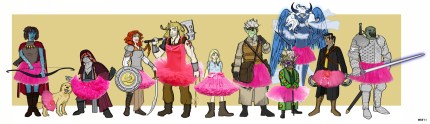
The Lodestar Crew, in their finest. ARTIST/W.Steven Carroll
Lodestar is an odd beast. Telling a story live for two years across thousands of words online, and scores of tabletop games it’s easy to get lost in the thickets. At least I know I often did, and at least nominally I was in charge of the story. Killervp asked for some Lodestar related blather, so I’m obliging. These are 5 things that the players either never knew, didn’t notice, or never encountered. Some of these are missed plotlines, or NPC backstories — or just things that I thought about a lot in the shower, but never actually mentioned in-game. Now that I had some time and distance from the story, here are a few things way back in the freezer of Lodestar.
1. The Precursor Homeworld
Oh, man. This was going to be amazing. Admittedly, this was part of the ‘Machine Unleashed’ end of Act 3. [More on that later in the list.] After a few failed attempts to defeat the Machine, the crew of the Lodestar was going to discover a hidden cache of Precursor knowledge [through clues in the sadly neglected Arkanic Computer, Carbunkle.] and discover Teon’s notes reconstructing the route back to the homeworld, along with the Song of Change that would have finally unlocked the Lodestar’s sleeping heart/psyche. [LEVEL FIVE!!!] The whole ship was going to gain an Interstellar Travel Mode in epic Flight of the Navigator fashion and the crew would have gone on last ditch quest across the stars.
There they would have encountered the Dark, the nebulous force of ultimate evil that forced the Arkanics to flee to Aufero. I don’t know what it is, but it scares the shit out of me — so, definitely nasty. Making their way through a shattered planet, finding lost technology and twisted Precursor-spawn — fleeing from the ultimate negation, the destroyer of all. They would have no chance of defeating it, but would have found something that allowed them to defeat the Machine. A glimpse into the larger cosmic battle beyond their own world — and foreshadowing for the next tale in Aufero.
2. Shadar Logoth
Ah. My unabashed crib from the Wheel of Time series. In Jordan’s first book, it’s a lost city filled to the brim with an ancient evil. In middle school, it really fascinated me, so I wanted to have it in my game world.
Immediately after the crew saved Talitha from the Shadow Knight in Brom, they had to deal with the temporarily-riderless and wounded Giant Roc, Bird. The druid managed to tend the creature’s wounds through and pulled a sizable stone chunk out of one of the bird’s wounds. A quick inspection revealed that it was overloaded with negative energy, a clue that the party could investigate to lead them to Shadar Logoth. They would have found an open conduit into the Umbral Plane, and the remnants of Izus’ battle with a large manifestation of shadow creatures. The players didn’t really miss much, but it was an opportunity to learn a lot more about the Plane of Shadow much earlier in the campaign.
And, of course there would have been a dagger with a ruby in the pommel.
3. Enton Blake, Scion of the Neclord
Oh, this still burns my players — because they know they missed this one. So, not totally a secret, but I like to rub things in.
Early in the campaign, I ran a ‘murder mystery’ adventure styled around Murder on the Orient Express. The main point of it was to introduce a new antagonistic group, the Seafoam Trading Company. The somewhat-evil multi-national conglomerate that controlled most airship and naval commerce in Aufero. There were about eight red herring suspects, and unfortunately I made the clue to who was the real killer too hard to notice. So, they had their ‘drawing room scene’ and accused one of the Vice Presidents of Seafoam with the crime under the evidence that he was an evil dick. He was evil, and they had a good fight — but he wasn’t the killer.
The real killer was that guy’s nebbish secretary, Enton Blake. I wrote a ‘confession‘ of sorts here on the blog several months later. And he was a vampire.
If they had uncovered the true killer, it would have served two purposes.
It was a neat link to the old campaign that spawned this game world. The Neclord was a master vampire who nearly toppled an entire country with his schemes. The old heroes had quite a time dealing with him, so I liked the nod to the old campaign.
Enton was the only Scion remaining — the only Child of Zed to survive the purge by the Forces of Light. His mission in life was to keep his existence a secret, as he slowly prepared over many, many decades the return of the vampires. Not quite sure whether he was going to resurrect the Neclord, or BECOME THE NECLORD HIMSELF. MWAHAHA.
Hey, you know what? It can still happen! Thanks, heroes!
4. Nyver Moonbeam and Jan Wise.
Sometimes you have a really cool backstory for an NPC or villain.
Sometimes you are just about to open your mouth, and lay down some narrative jazz and blow the players’ minds.
Sometimes the players kill that NPC or villain. Right. Before. The. Reveal.
Early in their career, the Lodestar crew did some work for a local crime lord in the city of Flenelle, a Dark Elf known as Nyver Moonbeam. They uncovered the edges of some sort of nefarious plot he was hatching, and decided they needed to take him down. They enlisted the aid of an alcoholic ranger named Martin Wise, who had a serious grudge against the crime lord.
When the party went to face Nyver, it was in the wreck of an abandoned galley that had been turned into a saloon. He had a female bard chained to the wall, forcing her to sing for him in between intermittent bouts of torture. The barbarian freed her, but they wouldn’t learn much about her until later.
As mentioned, the party made quick work of the nefarious Dark Elf. The only little nugget of the backstory I managed was his dying words to the ranger.
“You know I really loved her.” Nyver sighed.
“It don’t mean a damn.” Martin Wise replied. “And you know that too.”
“Yeah.”
So, yeah. Here’s the big backstory. Martin’s daughter, Jan fell in with Nyver early in his career. She was his lieutenant, and eventually his lover. The wrinkle was that the dark elf had a predeliction for causing pain, an inescapable compulsion. Jan allowed herself to receive the brunt of his abuse in an attempt to help him work through the condition. I don’t think she enjoyed it, but she was a willing participant.
Enter her father, the renowned ranger and adventurer, Martin Wise. He rolls into town and finds
By Rui Tenreiro.
bruises and scars on his little girl, and immediately commences to tracking down her villainous boyfriend. An epic duel erupts, Jan gets caught in the middle, she dies.
Ironically, much of Nyver’s sado-masochistic leaning is broken in this event. He still feels the compulsion, but then he will see Jan’s face on his victims and stop. His bard prisoner had some clues to the effect.
Martin started drinking, and didn’t stop. He even sunk to the level of taking odd jobs from Nyver’s growing criminal syndicate to make ends meet. He had some ale-soaked thoughts about working his way close enough to the dark elf to get revenge, but they didn’t amount to much.
5. The World of the Machine
The other way the last half of the campaign could have gone. The entire first arc of the game involves the discovery of the Shadow Plane — and some sort of being trapped within that is frantically trying to break into our world. Through travel and investigation the Lodestar crew learn that the trapped entity is a giant machine, built by the Precursors to destroy the evil that filled their homeworld. In typical Frankenstein fashion, they made it a wee bit too powerful. A large portion of the race’s population sacrificed themselves to create the Shadow Plane and imprison the machine.
The big moment at the end of Act 3 hinged on two options. Will the heroes stop the Machine from breaking free, or will it run amuck across the globe?
To my chagrin, the heroes succeeded.
But, oh. The Machine. It was going to be so freaking sweet. Just stomping its way across the world, crushing cities to dust. The party was going to need to ally themselves with Seafoam [and maybe the devils and Izus] to even have a chance to survive long enough to get to the next leg of the adventure.
I just loved the idea of spending over a year building all these communities, cities and countries — then pulverizing them. Admittedly, the 13 Day War that came later did just as good, but it was going to be a giant robot!
I am beyond excited….and more than a little terrified. I actually have an artist working on the cover art for Spell/Sword.
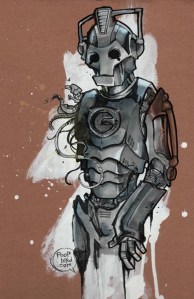
Cyberman – Mike Groves [poopbird]
I insist that you click on this super-rad Cyberman art and check out some other examples of his work. He’s got a lot of style-flexibility, but everything he does is interesting, distinctive and [as mentioned] on the north side of Rad. We had a great brainstorming session last week, and I should start seeing sketches in the next couple of weeks. I almost wrote ‘barnstorming’. I really want to have a barnstorming session in the immediate future.
Mike Groves – aka Poopbird – is a phenomenal artist, living in my hometown of Athens, GA. You should follow all of the links below and rub your grimy internet-hands all over his virtua-product. He is also an amazing tattoo artist, so if you need some ink (especially nerd-ink) he’s the man to call.
I can’t wait to see what he comes up with — even though the anxiety-engine in my head is already revving up. Cover art means we’re getting closer and closer to the book being real, and launched into the world where everyone will hate it.
That’s not to say that it is a falsehood, or a pure fabrication. Certainly there are many who call themselves salesmen that deal in outright deceit, but they’re just liars. Plain ordinary liars.
No, salesmanship is all about awareness. Complete knowledge of the product: it’s particulars, benefits, problems, logistics and idiosyncrasies and your most reliable perception of the character of your customer. Everything you say, everything you withhold is an attempt to calmly weave the product into the customer’s needs and desires. You concentrate on what you know about the product, and carefully present only the parts that you intuit will be attractive to your mark. You are creating a narrative, a workaday tale — a story with purpose. To make the sale. To win.
This is antithetical to the creation of art. An act of art should always be an act of truth. Individual truth — the opening of the inner eye and allowing the energy of your private whirlwind to express into your medium:something. Anything. As long as it’s true. Or real. Or important.
I’m still a ways from publishing Spell/Sword — but I’m already thinking about how I am going to sell it. The plan remains to self-publish, then grassroots my ass up the zeitgeist to something more than a blip. Financially and culturally. So I need to be able to sell the book. To other artists, to family, to friends, to total strangers, to people who love fantasy, to people who hate it, to people who never read. But every time I approach the problem in my head, I feel this enormous lassitude. It feels wrong.
In my day job, I am a salesman. I’m extremely good at it. But the key seems to be my total lack of concern. Apathy towards the product, and disinterest in actually making the sale. It allows you to be dispassionate and objective — truly focused on reading the situation and the customer. But with the book, where I’m hopelessly invested in the product and emotionally overwraught in the sale – it’s much more difficult.
It doesn’t help that I’m specifically trying to find my own little niche in the genre. It feels cheap to say “Oh, it’s just like ‘X’ and nothing like ‘Y’, and if you like ‘Z’ then buy, buy, buy!” But when I try to pitch it on its own terms, it just sounds hollow and uninteresting.
There’s a guy, and he has a sword. And there’s a girl and she’s got magic. They don’t like each other, then some shit happens and then they do. Also: hi-jinks.
I could do a laundry list of the random things in the book.
Electric-Eel Powered Jukebox. Prescience. Dwarven ghosts. Lesbian bards. Sweaty wyverns. Hangovers. Friendship. Mailboxes. A devil-spawned assassin. Fairy tales. Horse euthanasia. Wizard duels. Mysterious backstories. Prophetic dreams. Cheese. Plot-holes. Garden plots. Sorcerer bondage. Magic swords. An ogre with red boots. A blue fish. A white bridge. A first kiss. A last breath. Hyper-intelligent frogs with steam-powered roller skates. Banter.
Okay, I wound up kind of liking that one. But still, the problem remains. All that sounds fun, but I don’t know how convincing it is. Part of me wants to sell the book the same way that I wrote it. Honestly, with great love and with no artifice. Well, maybe a teensy bit of artifice.
This is important. This is true. This book is real. It matters. Or at the very least, I need it to matter.
So, yeah. Buy it or whatever.
Oh, my. This question is in bold. On WordPress, that’s like a Tumblr post dissing Doctor Who — it demands a response. What do you look for on the back of the book, or in a sales pitch for a book, when you’re considering reading something from an unknown author?
Certainly they can be built inside the human mind, but at least in my experience, they often come from elsewhere. The ether, if you will. Often when thinking of a character name, or a detail I just make a space in my head and let the idea pop in. I have total faith in these moments, even though I couldn’t explain the rationale if I had a gun to my head.
Admittedly, this may just be a justification for an unwillingness to slog. An idea presents itself, complete and shiny — why go through all the work of outlines and planning and research, just tune in the radio station and let it blare.
But, I am intrigued with the physical precense of ideas — that they could have an origin…and a purpose. With the past few stories I’ve been working on, I’m rolling around the concept of an Evil Idea. A malevolent entity that travels in the heads of mortals, infecting them like a virus. As weird as that piece was, I guess ‘The Option’ is a good enough name for my Big Bad as any.
This is a bit of a re-tread of Inception’s philosophical themes, the power of an idea — the immortality of an idea. Same goes for the V for Vendetta memes flooding the internet yesterday, you can’t kill an idea. People live and die for ideas, the course of entire civilizations turn on one or two great ideas.
That sounds like a great villain to me.
Is this too esoteric to support some fiction? Just too weird? Thoughts? Can’t you see that this question is in bold?!?!?
Gustave Doré Plate XX – “Lancelot Approaching the Castle of Astolat,” circa 1867-69
Write only what you know. You are in danger, Scholar Dryden.
My name is Emory Dryden.
I sit in my study in the East Tower. I am left-handed, and have to hold the quill carefully to avoid getting ink on my palm. The fire has died to embers. There is a brown plate to my right with a stale piece of bread on it.
It is two hours before dawn, by my estimation.
I can remember my training, and my years of service in the Legion. The Iron Legion of Gilead. The surplice that I wear is a faded green, the color of my order. The Knights of the Scroll. Those that rise above the rank and file of the Legion join one of four chivalric orders. The Scroll, the Bow, the Sword, the Wand. The Scroll is the order tasked with military intelligence — espionage and research.
I am studying a recording. A recording recovered frm aaaa
I am sitting at my table, in the center of my chamber. The fire has died to embers. The brown plate, the stale bread.
My name is Emory Dryden. I am a Knight of the Scroll.
My mind is my weapon. I will not surrender.
There is something inside me. The plate is brown. I must remain calm. The bread is stale. I must keep writing. I am sitting at my table. Understand and defeat this enemy. The fire has died to embers.
The words. The words of Teon. They have infected my mind. Somehow, I don’t knowwwwwww. The plate is brown and my surplice is green and the bread is stale and the fire has died to embers. Is this what he meant? It isn’t over. The plate, the green, the stale fire has died. Is this the Dark ooooooo—- the green plate fire has died of stale, the fire green plate has stalled and died, I am Emory Dryden I am Emory Dryden and I am a Knight of the Scroll -fire plate stale green brown died embers, embers the embers, the embers the EMBERS I must fire stale bread, stale bread must fire embers burn, embers burn, embers burn, embers burn——-the plate the bread me the tower the embers the knight the night the hand the left the right the stale the end the fall the flwr–
Impressions of the Speaker: The Arkanic language is an oddity. Rhythmic and focused, but with a strange undercurrent – as if the speaker is humming a harmony to every word. When written, the complexity of the symbology and mathematics at work are staggering — but when spoken, it seems to hover on the edge of sensibility. As mentioned earlier, a simple Translation Enchantment is sufficient to make the words understandable– but I find myself listening again and again to Teon’s words in their original form.
Greg Guillemin
The words are alien, but I find myself deeply affected by them. Teon is clearly in great pain, but there remains a quiet beauty to his speech. I compare it in my thoughts to an oboe, old and showing the impression of many careful stains in the wood. The moments where his reverie lingers on his lost companion Jalyx, his tone lightens before dipping again into the morose chords of his tale.
The beginning and the end of the recording, his words show clear signs of hysteria. His words crowd together, speaking too fast. Towards the end of his tale, his words grow further and further apart — until he falls silent for several minutes. When he speaks again, it is with great terror and desperation, referring to the removal [?] of his left hand. I have listened carefully to the silent minutes several times, but can detect no sounds other than a low sigh, which I presume to be Teon’s labored breathing. In the dark hours of the night, I half convince myself that I can hear a slight scratching sound on the recording — but my daylight ears can detect no such noise. I attribute this to a simple trick of my distracted imagination.
But taken all together, his words leave a clear impression. A learned, gentle man caught at the darkest of moments. I would not presume an unwelcome familiarity to such an august personage, but I must add: I like Teon. I sadly believe that much of the recording is a result of his delusions, or the pain of his mortal wound — but I still find his plight deeply affecting. It would not be wrong to say I grieve for his passing. Strange, I admit. This recording seems to come from the end of the Arkanic Civilization, which our scholars place around -1564 VA. This means that Teon has been dead for 2,729 years. But I am [perhaps?] the first to hear his valediction.
I mourn him, as if he had passed days ago. I will not mention this in my formal report, it is not germane or pertinent.
Origin of the Precursors: It seems clear from Teon’s words that the Arkanic race came from not only another planet, but perhaps an entirely different dimension. This flies in the face of much of current scholarly hypotheses. Also, the brief mentions of their sound-based technology is fascinating. I am not a specialist in that field, but I hope that these brief allusions will be illuminating to my colleagues.
I am uncertain about his description of how our world ‘pulled’ his ship into its orbit. Perhaps this is the memory of a child in danger and stress — being recollected by a dying man. I was startled to hear him use the name of our planet, Aufero, with practiced ease. I have never studied the origin of our world’s nomenclature, but I shall make it a point of study when time presents — but how remarkable that the planet has carried its name for nearly 3000 years.
Artist Unknown
The End of the Precursor Civilization: Here, Teon is maddeningly vague. Clearly it was a subject of great distress, but I wish he could have been more specific. What is this Machine that he refers to, exactly? It is clear that it was constructed as some sort of implement of war to battle the ‘Dark One’ that destroyed their home world — but what was it? If it was as potent as described, how can no signs of it remain? Something created by the Precursors’ own hands, that brought down their entire civilization — surely some relic must have endured for our study.
Side note. Teon refers to the ‘Dark One’ several times, but is strangely inconsistent about his usage. Initially it seems to refer to a Death-figure, similar to the depiction in many of our current cultures. But then he attributes the destruction of his home world to this being’s forces. Regardless, this Dark One seems to be a major figure in the culture/religion of the Arkanic people — I must cross reference this with the iconography of the murals found in the Gryphon Ruins near Quorum. So much study, so many new avenues opened by this simple recording!
Inconsistencies: There are several portions of the recording that do not seem to bear up to scrutiny…
A recurring complaint from my Alpha Readers — and now one of my Beta Readers, is that I don’t tell them enough. They want more details about the world, more about the history of the characters.
I have two main characters, and I sort of summarily dump them into the plot together. They both have Dark Pasts and Important Backstories [tm], but…and this is the crux, their backstory doesn’t have anything to do with the plot du jour. The amorphous goals that I am moving Spell/Sword towards are pace, energy, and involvement. I don’t want to put any woolgathering or world history navel gazing — just accept the tropes and characters as presented, and show me a little trust. Epic fantasy tends to frontload all of the exposition and world detail, I just want the reader to strap in and go along for the ride. This is episodic structure, not an epic trilogy.
A good example of this would be the pilot episode of Firefly. Admittedly, not a perfect example — that’s a vast ensemble. You’re only shown enough about the world and the character to serve the plot of the episode.
Okay, it’s in space. Mal was in a battle, his side lost. Okay, time passed. Oh, it’s the Civil War. I get it. Hmmm, Asian influences have become culturally dominant. Evil Empire, band of mercenaries and thieves. Okay, Mal’s a rogue with a conscience, Zoe’s a devoted soldier, Wash is comic-relief — oh hey, he and Zoe are married. Jane’s a thug, Kaylee’s an innocent mechanic, Inara’s a diplomatic courtesan, Book’s a priest, Simon is a rich kid doctor on the run, and River’s nuts. Oh, she’s super powerful/insane/government project — the empire is going to hunt her the entire show, hook set for the arc of the first season. Ooh, Reapers are nasty.
You don’t get the description of every major location in the ‘Verse. You don’t learn anything about the actual setup of the Alliance government, or the name of it’s ruling body. You don’t know how Mal got from being a defeated solider to captain of Serenity, you don’t know anything about Zoe and Wash’s courtship. Book has about eighteen arrows pointing towards him that say MYSTERIOUS SECRET — but, none of that resolves in the first episode. Whedon throws all these tropes into a ship, lets them rattle around a little, then unmasks the sleeper agent who tries to capture River. The character and world exposition always takes a backseat to the action of each scene — and more importantly, the character relationships. The family dynamic of the crew and the budding connections between the new passengers — and their reaction to the imminent danger at hand is what makes that episode work.
We all know right off the bat that Book used to be an assassin. That’s a trope, the holy man who put down the sword. It appears again and again. Whedon could have spent 10 minutes explaining about the Alliance Death Squad and their memorable exploits, but that’s now what makes a work of fiction interesting or memorable. What makes Book more than a trope is his relationships — his seeking out of wisdom from Inara, his antagonistic mentoring of Mal, his almost paternal relationship with Jane.
That’s how I’m trying to view this first book. It’s the first episode. Here’s my wacky duo, here’s their powers, here’s a little sniff of their past, here’s some action, here’s some villains, here’s some crazy, there’s some weird, and hey, book’s over.
One of my favorite episodic novels. The Dresden Files is a good example. I almost stopped reading after the first one, because so many pages were devoted to explaining exactly who Harry was, the various supernatural forces around Chicago, how magic worked, how making potions worked, the backstory of his cat, the backstory of his car,etc. etc. — only when I picked up book two, and all of those details were read did the kick-assery truly begin.
So — to sum up. My goal is to write my very first book and have it be just as good as Firefly and Book Two of The Dresden Files. And I’m going to self-publish. And this doesn’t sound very likely does it?
I have been listening to my Alpha Readers — there was a significant increase/clarification of world and character information in the Beta Draft. But, there’s got to be a line. There is an argument to be made that leaving my readers wanting to know more is a good thing — but I’m a little terrified of leaving them annoyed, instead of motivated.
I am courting my readers, dammit. And I’m just not the sort of girl to throw up my skirts on the first date.
Ultimately, I’m in the weird position of being beholden to no one as a self-publisher. I don’t have an agent or a publishing house demanding that I add more romantic tension between the main characters, or insisting that I cut out the Steam-Skating Frogs as nonsensical. But I also don’t have the advantage of their experience either. I can write it however I want, and no one can stop me from spending a few days on Amazon putting it into print.
Man, it must be relaxing to have an editor.
I’m just starting to get weary of eighteenth-guessing everything in the book. I have a legitimate fear of totally abandoning my own judgement and just cramming in every possible thing into the book that anyone could ever want to see. And winding up with a big ungainly, craven mess. OR not doing that, and putting out an austere, confusing desert.
“a Witch is born out of the true hungers of her time (…) I am a child of the poisonous wind that copulated with the River on an oil-slick, garbage infested midnight. I turn about on my own parentage. I inoculate against those very biles that brought me to light. I am a serum born of venoms. I am the antibody of all Time.”
― Long After Midnight, Ray Bradbury
Doesn’t that just make you sick? I have a witch in Spell/Sword, and several of my early readers have asked ‘What’s the deal with this witch?’. I’ve tried several times to explain with rambling and halting description. Then I came across this quote on Tumblr — perfectly summed it up. Freaking Bradbury.








 spell-sword.com