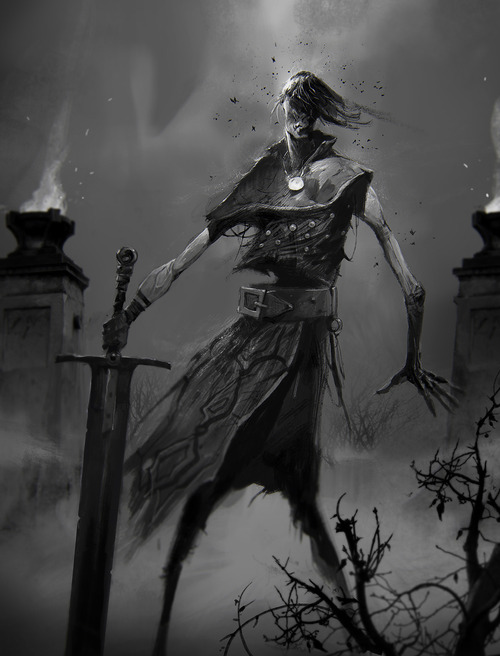
From the Beginning of Time through the Storm Century

But of course I can tell the Story, what do you take me for? Do you not see the mark of Brightnail on my chest, do you not hear the song on my lips? Ach, pass me that flagon and I will say the words. We are all travellers, and it is good to return to the beginning when we can. And push those sugared figs a bit closer, my dear. Now, let me see, let me see — ah, yes, I have it — just as it has been spoken by the members of my order, just as old Prago told me when I was small.

Before Time, we do not speak.

But then the first minutes washed up on the shores of the dark ocean, and a story blinked its eyes and brushed sand out of its hair. We can hear its voice even now, we listen carefully to the quiet groan of the earth, the sky, the jangle of stars in the black belly of night. We tell the Story as it tells us.

At first there were only Two. Father Order and Mother Chaos found themselves here, on this simple globe. The Story does not know if they were born here or if they came from the dark ocean, but suffice it to say that in the first minutes they were here and it was a Beginning.

And they danced.

Mother Chaos would break and tear as fast as her dark hands could move and Father Order would build and mend just as quickly. Father Order would raise tumblr_mwq90d4TZF1sppixgo1_500great towers and shining bridges with his bright hands and Mother Chaos would laugh and shatter and bring them all tumbling down.

And for a time, it was enough.

But then the Two grew bored.

“It is so lonely here,” Mother said. ” So flat and empty. I grow weary of breaking the same towers day after day.”

“As I grow weary of building the same towers,” Father grumbled. “I’m guessing that you have a suggestion.”

Mother grinned “Yes, of course I do. Let’s play a game.”

“A game?” Father mused. “What kind of game?”

“A Game of Making! Together we can fill this world with all sorts of interesting things. We’ll take turns! It requires both of us to create, but we can take turns and see who makes the most interesting thing.”

Father Order scratched his nose and grinned. He was certain that Mother wanted to trick him in some way, but it was a grand idea nonetheless.  Chaos saw the excitement in his eyes and skipped in for a quick kiss before they began.

The Two joined their hands and began to make.  Order and Chaos met and the first living things drew breath. The first plants and the first insects, lichen and moss, fish and fowl, claw and talon, feather and hide. Father and Mother took great delight in the making, growing ever more inventive in their competition, endless variety in the nature of their creations. And in the heart of everything that lives an equal measure of Chaos and Order, the gift of the Creators.

And for a time, it was enough.

But then Father and Mother created People.

They had many shapes and sizes, many bends and ways — different races and faces and gazes, but still all the same, all People. One strange accident made them different than all the breathing things that had come before — or one careful trick that Mother Chaos had laid carefully across the long Time of Making, a tiny tip of the scales. Where before their children had shared equal measure of Order and Chaos – People had a little more of one, and a little less of the other. They gravitated ever so slightly towards rhythm or ruin — and since they were created last, they were the most intelligent, the most elaborate — perfect pieces for a new game.

Mother Chaos crowed with delight and Father Order frowned.

Father freed his hands and sighed. “I’m afraid this last batch is no good, they will be nothing but trouble.”

“No, they are perfect,” Mother insisted. “See, some of them are building away — they are your children, just as mine are blithely breaking and shattering. New dancers, new pieces for the game, they are wonderful.”

“Yes, some of them are quite industrious, and I’ve already been surprised at some of the things they’ve built,” Father sighed with regret. “But they must be destroyed. They are ever-changing and mercurial, see! Those over there have have fallen to you and are setting fire to the tall grass — and those over there have stopped breaking rocks and started building houses. What good are pieces that change sides? No, no – they must be destroyed.”

And Father Order raised his hand to end the People, and found Mother Chaos’ hand raised to thwart him. They locked eyes and the First Argument began.

A century of storms, tireless, ceaseless battle. The first People did their best to weather it and provide shelter to all of the other creations — though many of them were lost, obliterated by the tireless wrath of Mother and Father.

And thus our world would have remained, if not for one clever child and one stupid goat.

Ah, this is my favorite part. Drown my flagon again if you please, I don’t want to pause when I continue. Oh no! Can my plate of figs already be empty?

— Talespinner Marxo, Cleric of Seto, Idolobha
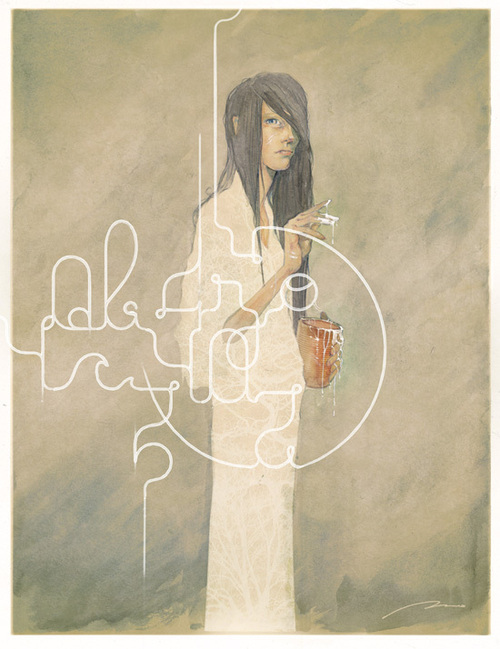
A Spell for Winter

It was cold that year. The grease-trap from the restaurant upstairs continued its slow leaking creep across her ceiling, but at least the snow-chill that invaded her square basement slab froze the yellow-brown sludge’s advance.

She had one window, covered with a

image
Artist – Bruno Vergauwen

lattice of mud and frost. From her desk piled high with paper and feeble penny-candles she could see boots pass in the street outside. Her means were few, so this afterthought coffin was all she could afford. Her gold had better use than wood, or steel, or bowls of wheat. Her gold was for paper, for ink, for magic.

The student held her aching hands as close as she dared to the forest of tiny yellow flames, a rainbow of mismatched candles. The cold would not leave her joints, and the rudimentary spell she had been attempting required an exacting sequence of hand gestures.

“Preposterous,” she grunted, as she often did privately at the endless flailing and chanting required to produce even the most basic of magical effects.

She re-read the passage again, her eyes blurred with repetition and the dull ache between her ears. With grim focus she spoke the arcane words, stumbled over the final consonant, began again, her knuckles full of broken glass she made the careful sigils.

And to her surprise, it worked.

A small gout of flame appeared. Golden and bright, but only for an instant.

The student stared at the empty air in disbelief.  She let her hands fall to the cluttered desk, her gaze empty.

“I did it.” The student whispered to no one. “I finally did it.”

She let her head fall slowly to the desk for a moment, then pushed herself up. No coat, no scarf she walked up the cracked stone steps and out into the snow. She took a deep, cold breath. Her lungs full of winter she looked up at the heedless stars and told someone, “I did it.”

World Under Construction – Matters Divine

Pray to the Gods if you must, but do not mention my name if you catch their ear.
—  Dwarven saying.

Cynus is a strange land, filled with an extremely diverse population both racially and culturally. Some scholars have made note that the widespread worship of the Balance across many geographic and ethnic divides is less than likely  but those same scholars keep these observations private. This pantheon of primal gods are not known for their positive attitude towards criticism or mortal interpretation.

The Six, as they are sometimes called, also provide ample proof of their existence on a regular basis. Sometimes in the form of a vicious sandstorm or a unexpected drought or an earthquake on the eve of winter. Other times in the blessings of a bountiful harvest or a sudden break in a heatwave or a gentle breeze on the eve of summer.

The foremost are Father Order and Mother Chaos. Their names are never spoken, one out of respect, the other out of fear. These deities affect and scope are so beyond the mortal ken that they have never recognized any sort of church or acolytes. A few have appeared throughout the centuries, but none were able to display any sort of true connection or divine power, so they soon were discredited and forgotten.

Mortals have much more luck with the other four gods, the children of the Two. Or perhaps it is misfortune, because the other gods never tire of meddling in the affairs of the world. And much like the four elements they represent they can bring great bounty and great destruction to the world in even measure. It is said that Father and Mother ceased their tireless battle only once to couple, but only with the foreknowledge that their children could multiply the conflict between Chaos and Order a thousandfold.

Seto – Goddess of the Sun [Fire]
Banu – God of the Sea [Water]
Marrus – God of the Sky [Air]
Jocasta – Goddess of Stone [Earth]

The gods are neither malevolent nor benevolent, not truly. Human experience and custom has lead many to consider Seto and Banu as generally more giving and understanding than their siblings — but a flood can still drown, and the sun can still scorch.

The Children of the Balance speak when they have a will, through their chosen vessels – clerics, paladins, druids, oracles. But any can invite the gods’ attention through the proper rituals — though this is usually done only at times of great need.

A few other deities are recognized in some locations throughout Cynus, and they seem to have similar influence to the Balance. The worship of these minor gods seems to have begun during the Blank Time, a period of years where the the entire pantheon of the Balance seemed to have vanished entirely.

World Under Construction – Matters Divine

Pray to the Gods if you must, but do not mention my name if you catch their ear.
—  Dwarven saying.

Cynus is a strange land, filled with an extremely diverse population both racially and culturally. Some scholars have made note that the widespread worship of the Balance across many geographic and ethnic divides is less than likely  but those same scholars keep these observations private. This pantheon of primal gods are not known for their positive attitude towards criticism or mortal interpretation.

The Six, as they are sometimes called, also provide ample proof of their existence on a regular basis. Sometimes in the form of a vicious sandstorm or a unexpected drought or an earthquake on the eve of winter. Other times in the blessings of a bountiful harvest or a sudden break in a heatwave or a gentle breeze on the eve of summer.

The foremost are Father Order and Mother Chaos. Their names are never spoken, one out of respect, the other out of fear. These deities affect and scope are so beyond the mortal ken that they have never recognized any sort of church or acolytes. A few have appeared throughout the centuries, but none were able to display any sort of true connection or divine power, so they soon were discredited and forgotten.

Mortals have much more luck with the other four gods, the children of the Two. Or perhaps it is misfortune, because the other gods never tire of meddling in the affairs of the world. And much like the four elements they represent they can bring great bounty and great destruction to the world in even measure. It is said that Father and Mother ceased their tireless battle only once to couple, but only with the foreknowledge that their children could multiply the conflict between Chaos and Order a thousandfold.

Seto – Goddess of the Sun [Fire]
Banu – God of the Sea [Water]
Marrus – God of the Sky [Air]
Jocasta – Goddess of Stone [Earth]

The gods are neither malevolent nor benevolent, not truly. Human experience and custom has lead many to consider Seto and Banu as generally more giving and understanding than their siblings — but a flood can still drown, and the sun can still scorch.

The Children of the Balance speak when they have a will, through their chosen vessels – clerics, paladins, druids, oracles. But any can invite the gods’ attention through the proper rituals — though this is usually done only at times of great need.

A few other deities are recognized in some locations throughout Cynus, and they seem to have similar influence to the Balance. The worship of these minor gods seems to have begun during the Blank Time, a period of years where the the entire pantheon of the Balance seemed to have vanished entirely.

World Under Construction – Tone Poetry

Artist Unknown
Artist Unknown

The secret roads of Night
the falling leaves of Autumn
the bright blade
shining in the dark.
Farewell to kith
and farewell to kin
we go forth into the Forest
hunting monsters
and singing strange songs
in the bower of Dawn.
We have no family
except each other
no story
except this one.
The fire burns in the night,
but is ashes come the morn.
Will you come and ride with us?
Will you come and die with us?
This is no time for heroes,
but the road calls all the same.
This is no time for heroes,
but we will remember your name.
— Swordkeep’s Song by Tyrol Limmermere
First Bard, Court of Pondegrance 1501


World Under Construction – Notes

An adventure needs a place. A simple place, to start — familiar, but just barely. A starting place, a place of no particular importance other than it is the place where We Began.

I want this one to have trees. A forest, though not an old one. A forest and a small town, a simple town.

Or is that too easy? Is that too much of a cliche?

I already did that one, in Riddlewood and Creon. The Young Heroes.

I’ve already done the Prison, and the Festival. The Devil’s Forge, a stone prison locked in by heat and thirst — -the Festival of the Grove, celebrating bounty among the dust and death of the endless desert.

What else is there? They Meet in the Bar? Drawn by Destiny? A Final Request?

Eh, if the cliche is boring, I’ll add an adjective. The trees are tall, the spire pines. They grow as fast as bamboo, you can hear them groaning in the night — tumblr_mrfenj0Axx1rcagdmo1_400but they never break, except by the touch of crystal axe. Does the town mine the crystal? The wood is useless, it burns poorly, and once cut from the trunk it becomes brittle and gives off a pungent smell, like stinky leather shoes left in the rain.

The town was once a city, but now the vast expanse of it is in ruin.The Spire Pines were summoned by a vengeful [druid? demon? god?] because the people angered him, most of the population migrated because of it — only a small…mine keeps the town in operation.

Is the mine too obvious? Because clearly the first adventure would take place there. Hmm.

What if the mine is suspended in the air by the spire pines? The metal contained there was so dense, that the pines could not pierce it, pushing it higher and higher into the air every year. The miners must first ascend the trees, and take great care, because a cave-in could result in a thousand foot drop to the city below. The denizens of the town take great care that their homes are outside the blast perimeter, as clearly one day the mine will fall. Should it be adamant? A precious resource in Pathfinder, but maybe too useful to give the party access to this early. But it would be unrefined…maybe.

There would have to be an inn directly  under the mine, the Pancake. Hard-scrabble miners and unsavory types. Last call is always the toast ‘Fall flat! or ‘Squish me before I have to go home.’

Why is the party there?

So.

Why haven’t you bought my book yet?

[Legit question — ‘never heard of it’ is perfectly acceptable, just trying to do some un-scientific polling. Drop a comment here or on any of my internet edifices.]

December Remember Dismember, So Soft and Tender

Yeah, I don’t know either. It’s a title, a title to a blog post!

I am in Hell Week of our production of Romeo & Juliet, so my brain tachyons are being primarily targeted against that creative project’s deflector shield, but I’ve got some dribs and drabs. BULLETED LIST.

  • Editing on The Riddle Box is at a standstill until this weekend, but I’m still on target to get it hammered into a readable shape for my Beta Readers by,
    Buster Keaton
    Buster Keaton

    let’s say…. DECEMBER 15th!!!!

  • I’m not excited about the new Hobbit movie, and that makes me kind of sad.
  • Another writer online is attempting to sell on-demand short stories, poems…and even novels. As in made-to-order, you tell him what you want the story or book to be about, and he will write it for you. He’s even offering live slots to watch the writing happen on Google Drive. I just…have really mixed feelings about that. On one hand, I don’t begrudge any writer their path to supporting themselves with their craft — but on the other hand it seems just unnecessarily mercenary and disrespectful of our art? Writing as product, built as easily and quickly as a pre-fab house in a subdivision? Logically it’s no different than writing professionally for a magazine or newspaper, but something about it just grinds my gears a touch — mainly because, shouldn’t the best use of your skill be to make, you know, art? Maybe just the thought of some phantom observer watching me write just makes my skin crawl.
  • Sleepy Hollow is endlessly charming and they just hired Victor MF Garber to play Ichabod’s father. Reverent squee.
  • Almost Human is delightful and I will punch any that disagree, the adventures of Eomer and Sassbot 9000 are a must watch for me.
  • Agents of Shield continues to grow and shake off it’s wobbly plotting — except for Skye. Seriously, writer — time for a pow-wow, figure out what story you want to tell with this character. Using her as the constant ‘dumb-question’ Window Character or SHIELD-doubter is completely played out. A disservice to the actress, and to the world you are building.
  • I’m directing Oklahoma in the spring …I should probably do some prep-work for that and confirm my production staff.
  • DM Burnout Tour 2013 continues apace. My Pathfinder group seems to be enjoying the published adventure I’m running, but I haven’t even had time to prep that properly. Need to do my nerd diligence before we play again on the 16th.
  • I wish I had time to play video games.
  • And see my Beloved.
  • And the four-footers.
  • Shadeaux Bros. holiday album is in pre-production.
  • There is a bizarre attitude one must affect to keep moving forward while self-championing your art. This bizarre blend of cocksure arrogance and razor-sharp anxiety, slathered over with a chocolate shell of delusion. Mike Birbiglia has  a great bit about it.
  • Spell/Sword makes a great holiday gift!

The Sage is In [Round One]

I put up a status on my FB fanpage asking for questions to fuel my next blog post. It’s been a while since I’ve activated my Sage prestige class, so please enjoy the shiny wisdoms here for your consumption. I’ll put up more as they come in.
Why do fools fall in love?

– Laura T.

What is a fool but an empty head?

Unencumbered by malice

or worry

or thought

they fall because

they fall without pause

gravity puts them

where they need to be

safe in the grooves

the record-turn of destiny

while we

the wise resist

our brains heavy and thick

with proud lines and numbers

clatter across the vinyl

while the fools

fall deep

into the simple clasp

of moss and time and

the slow revolve.

If you were going to play a pirate character in Pathfinder would you a) go Rogue or Fighter? b) what two weapons would you use? c) Drow or Tiefling?

– Daniel D.

Interesting question – I suppose it all depends on what type of ‘pirate’ that you have in mind. Are you thinking Errol Flynn – swashbuckler? Or more of an Edward Teach/Blackbeard – hardass murder dispenser? For the sake of this response, I’ll try to take the average of the two extremes.

a) Neither. I would go with a Ranger/Gunslinger multi-class. Dump most of your levels into ranger for the Two Weapon Fighting Style, and then focus all your Favored Terrain and Favored Enemy slots on aquatic types. Also training up a suitably vicious Animal Companion that could fight alongside you at sea would be wise, I recommend a Dragon Turtle.  Stack on 3-4 levels of gunslinger for the firearm proficiency and Grit points – a true swashbuckler could continuously fuel the Grit pool with all their feats of derring-do.

b) Falcata for main hand, Dragon Pistol for off. Your primary damage is going to be through melee, the spray effect of the pistol is mainly to soften up low-level mobs and disperse damage across a large group.

c) Tiefling. The bonuses to INT and DEX are key for a nimble fighter build, as well as the racial bonuses to Bluff and Stealth. Also Drow haven’t been cool since 1997.

The Riddle Box Beta Reader Worksheet


I’ve been working on a series of questions for my Beta Readers of The Riddle Box. The idea was for them to not read them until after they finish reading the draft, but I realized that if I carefully obscured the character names — and a few entire questions — it wouldn’t really matter if they read them beforehand — AND was sort of a backhanded way of revealing some of the things that all readers have to look forward to in the next book. Plus, I’m going out of town for the weekend, and felt guilty about my slow posting of late — and this is an easy cut-and-paste affair. This may be a huge mistake, but you can safely ignore the disclaimer at the top. OR CAN YOU? 

I also thought this might be an interesting ‘behind the scenes’ look at MY PROCESS. [Trumpets begins to blare.]


DO NOT LOOK AT THESE QUESTIONS UNTIL AFTER YOU HAVE FINISHED READING


The Riddle Box.


Seriously. Don’t do it.


These questions are chock-full of spoilers and things that could influence your first read for better or worse. I have some specific concerns about the book, and specific areas that I’m less than pleased with, that I want to make sure you mentally target as you give me feedback. I’m not expecting you to actually respond to these questions ‘in-line’ as if this were some sort of high school worksheet [unless you’re in to that], but please be thinking about them as you prepare your feedback in whatever form you prefer it to take.


1. Do you feel cheated by the solution to the mystery?

  • Did I break the rules of the ‘locked room’ mystery?

  • There are a series of murders, did the explanation for any seem thin, unconvincing, or illogical?

  • Which of the murders did you need more information about?


2. Did Jonas or Rime act in a way that seemed incongruous with their portrayal in Spell/Sword?


3. This book introduces more ‘world’ information than the previous, how did you react to it?

  • What, if anything, would you have liked to know more about?


4. Overall, The Riddle Box has much less action than the first book — or at least it’s nearly half-way thru before there’s a big fight scene. Did you notice the lack?


5. I introduced two ‘love interests’ for the leads in this book, [REDACTED] and [REDACTED]. What were your thoughts about Jonas’ and Rime’s reaction to these characters?


6. With regards to [REDACTED], I was playing around with the trope of the ‘Damsel in Distress’ — too heavy handed?


7. [REDACTED] is a  [OBFUSCATED] character. Were you aware of that? Should you have been aware of that? What thoughts do you have about his portrayal, in relation to sensitivity?


8. The entire novel takes place in one location, the Manor. Were you ever confused by the layout or description of the locale?

  • Did the passage of time seem reasonable and easy to follow?


9. The repeated conceit of the ‘flashback’ chapters, i.e. Who was [REDACTED]?  to reveal more information about the murder victims — how did you react to these chapters structurally? How do  you think they impacted the flow of the novel?

  • Did you have any individual issues with these interludes?


10. How did you react to the further revelations of Jonas’ past? Does it contradict anything established in the first book?


11. [KILLER]. Discuss.

  • Was [REDACTED] scary?


12. The denouement of the novel is a bit rushed. Do you feel any explanations were hurried or glossed over when you wanted more detail?

  • Does Rime need another beat where she processes [REDACTED]’s death?

  • Jonas doesn’t approach Rime with the knowledge that they are going to [REDACTED], is this a problem?


13. [ENTIRE QUESTION REDACTED]


14. [ENTIRE QUESTION REDACTED]


15. Jonas manages to subdue [REDACTED] twice via headbutt. Is this funny or lame?


16. The scene of [REDACTED] in the [REDACTED], did you find this scene effective?


17. Any other flaws in logic or plot?


18. What would you say the theme of The Riddle Box is?

  • How effectively was this conveyed?


19. Compared to the first book, how did this one measure up against your expectations?

  • If you have not read the first, how well does this novel operate as a stand-alone experience?

20. What do you expect to occur in the next novel? What would you like to see explored in the future?


Normal caveats. These are all questions about the rough draft, the novel can change massively between now and publishing.