Jonas closed the door behind him, the sound of rain hushed.
The grand entryway was covered with mushrooms. Sickly, purple and pulsing slightly – as if each bulb was taking a slow breath.
The green light bloomed from a pair of corpses sprawled on the marble stair. A pair of guards. The squire moved towards them, but then stopped. He didn’t want to know. Didn’t want to find the faces of old friends rotting on the steps. The light seemed to pour out of the vicious wounds on their neck and back, like an echo of blood, burning green and merry.
Jonas kicked the mushrooms aside in disgust and made his way up the steps.
At the top of the stair, a hand print had been charred into the wooden door. The squire placed his own hand next to it, to compare. The other hand was thinner, long fingers splayed.
Is this the devil? Luthen’s devil?
The squire wiped the water out of his face, and entered the hall.
Jonas landed hard on the stones of the parade ground, blood seeping from the deep gash in his leg. He retied the crude bandage, and forced himself to stand.
The rain fell.
The church was hours ago. It felt like weeks ago.
He had passed through the wet night, the sudden slide of cobblestone and slate roofs. A brace of once-men has surprised him in a narrow alleyway. His sword had prevailed, but one of the dark things had left the bleeding wound on his leg.
Now, at last he had pulled himself over the stone walls of the castle. An abandoned hay cart had provided a suitable ladder.
The windows of the castle blazed with green light. The same green light that filled the empty eye sockets of the dead of Gilead.
Jonas laid one chilled hand on the hilt of his sword. He pulled the good steel free, and stepped carefully through the open gates of the castle.
[This is condensed from several sources, there are very little hard “facts” about the Mysterious Continent — but these seem to be the most likely.]
The land mass of Altus wasn’t discovered until well after the Vardeman Accords in Year 54. The races of Aufero had mastered sea travel, and were eager to explore as much of the globe as possible. They found Altus to be almost impenetrable to sea access – massive rocky slopes, with shear sides, sharp as razors. The few expeditions that managed to penetrate the interior suffered tremendous losses, and brought back strange tales of volcanoes that spoke, rivers that sang, and roads that climbed into the clouds.
Few believed these tales — but the difficulty of travelling to the distant land mass – added to the lack of resources discovered lead to the exploration of Altus being abandoned.
[“There wasn’t any gold! “ Bragg chuckled. “ If one half-mad sailor had tumbled back with a fistful of gems, or some silver bangles — you can bet the world would have found a way to shinny up those cliff sides”.]
Airship travel was first developed circa 1006, and after the Flenelle Renaissance of 1019 hundreds of vessels of different designs and propulsion type filled the skies of Aufero. Despite the political turbulence of the past few centuries, a few brave explorers turned their sights to the Mysterious Continent.
And never returned.
It wasn’t until 1029 that a successful expedition returned. Led by Jaiden Moore [b.1010].
[“Seafoam was a mom and pop tugboat operation in those days. They had three scows that worked the harbor of Bard’s Gate, and a couple of ratty old hotels. Rent by the hour, if you know what I mean.” Tom, of House Brighella winked. “ Young Jaiden scraped up enough coin to get a an old airship up into the air, and across the sea — he was the talk of all Aufero when he came back unscathed. Toasted in every port and kingdom across the globe — he used the connections he made to slowly build trade agreements, and shipping covenants. Not to mention the rumors of the lost technology he discovered. I haven’t found any records of him showing off any discoveries, but it is a fact that Seafoam engineering soon outstripped almost any other airship firm — becoming the industry standard in a manner of years. Time passed, and soon Seafoam became the de facto governing body of the skies — and any ships that wander too close to Altus are turned aside by Seafoam cruisers and battleships. For their own ‘safety’, of course.”]
Seafoam’s fascination with magical relics, and any sort of Precursor technology has long led to many people theorizing that Altus is the lost Arkanic homeland.
[“Kythera.” Cai said weakly, his frail form covered with a blue blanket. “The Precursor’s greatest city – their home. The man who finds Kythera is heir to all of their knowledge, all their secrets.”
“I found a metal plate on the back of a strange mechanism in Carroway, it was covered with Arkanic script and a crude map of the globe. It took me a few months to decipher it — but imagine my surprise — it was an order form! For replacement parts, from the central depot in Kythera! The map showed a few symbols on the Altus landmap, but the largest was marked with the sigil for Kythera.”]
Just can’t do it — my finger’s been hovering over the Publish button on one of my old poems for a few minutes. It just fills me with horror to release these into the world — these are yearbook-bad.
So, would it get weird in here if I posted some angsty-ass poetry that I wrote nearly a decade ago?
Like, this weird?
I’m cringing at even the thought of doing this, but this blog is supposed to be about me as a writer — and for better or worse – GULP – I wrote these things.
All of them are super bad, but I dug through and found the ones that are the least embarrassing – I think…
The subway stank. Yellow plastic, scrubbed by rot and ignorant crustaceans.
Clack. Ka-chunk. Clack. Ka-chunk.
George looked out the window, the stone walls and blips of color a gray river.
His suit had been nice once, the red tie brighter and well pressed. Now the shirt was stained at the cuffs, the elbows of the jacket patched with the wrong shade of black thread. His hair was thin, and his face lined.
The subway emerged onto a wide trestle, and he could see it.
The stadium. Four spotlights waved, yellow, white, green and blue.
He pressed his forehead against the glass, and closed his eyes for a moment. He could smell the grass.
George sighed, and leaned back. He brought a hand to his collar, and ran a finger around the silver collar at his neck.
He had been Shackled for years — but he never forgot that he was wearing it. Not once. Not even for a moment.
George dug into the white cup of boiled peanuts, and fished around for a large one. He pulled out one that suited, and popped it into his mouth. He looked at the stadium again.
Placing the cup between his legs, George stared at his right hand – at his fingers. He covered it with his left, like a lighter in the wind. He pushed his eyes close to the little cave of his fingers.
George snapped. The barest wisp of green sparks popped to life at the end of his fingers.
He leaned back against the seat. He closed his eyes, and smelled the grass of the stadium.
The Lodestar Crew, in their finest. ARTIST/W.Steven Carroll
Take any fantasy plot, and try to explain it to the uninitiated with a straight face.
Guess what?
You sound like a crazy person.
I tried to write out the plot of Lodestar, leaving out all side plots, character plots, backstory, and world building — and reduce it to it’s essence. THE MAIN PLOT. How I would explain it to someone who knows nothing about the story, and nothing about fantasy. Here’s my first pass.
So, there’s this Gate.
Behind the Gate, is something Very Bad. VERY, Very Bad.
The only way to open this Gate is with Three Magical Items.
The Crimson Key.
The Blue Shield.
The Blood of the Precursors.
The first two items are fairly straightforward, but the third is the problem. It’s a bloodline, carrying the genetic structure of the Gate’s creators down through the centuries in a few human families.
Bad guys have sought the descendents for a long time. Other bad guys have been killing the descendents for a long time.
Bad Guys A want to control What’s Behind the Gate. Bad Guys B want to make sure that their Nefarious Plans aren’t disrupted by What’s Behind the Gate.
Enter the Heroes.
They’ve been protecting a Little Girl. A Little Girl who is the true scion of the bloodline.
Bad Guys A have managed to capture the Little Girl.
The Heroes have to get the Little Girl back, before Bad Guys A can open the Gate – or before Bad Guys B kill the Little Girl.
Can you hear me trailing off lamely towards the end? Cutting my eyes to the right, and regretting even starting? Let me try again.
There’s a Little Girl, and she’s awesome. And important. The Heroes have to keep her safe or the world blows up. Or something.
Now imagine me explaining this to someone on a subway, or an elevator. Can you see that person quietly reaching for their mace?
I guess it would help if I was wearing pants.
[What? Were you visualizing me with pants? Well, I guess that’s your mistake.]
Okay – okay. I know I hit the 45 page mark a couple of weeks ago — but 50 is such a nice round, impressive number.
It totally is.
I was hoping to hit 50 pages by the end of the year, so I’m stoked at being ever so slightly ahead of schedule. After the holidays, I’m going to make a plan for the next few months, so my natural laziness doesn’t derail The Thing That I Can’t Call A Book.
The rogue and paladin descend, the latter’s heavy steel footfalls clanking on the ladder rungs.
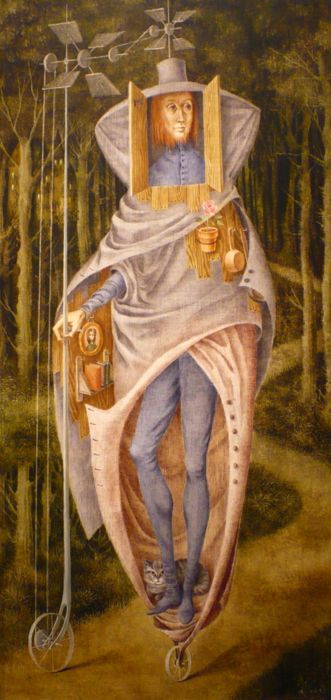
The Vagabond by Remedios Varo,1958. Oil on canvas.
At the bottom of the ladder, the mouth of a tunnel, carved from earth. They follow it for a short distance, the orange light blooming brighter and the sound of of wild violin music echoing against the tunnel walls.
After several minutes’ walk, the earthen tunnel gives way to quarried stone — one of the many ruins that the city is built upon. Strange bulbous mushrooms glow with bioluminescent glee, the source of the orange light.
The two adventurers pass several others as they come closer to the source of the music. Foul-complected thieves, wispy whores with glittering knives, and several cutpurses barely old enough to be away from their mother’s apron strings. Many accost the pair, but turn aside when Corben flashes the sign of Visiting practitioner.
At last the flood of traffic leads them to a vast cavern, hundreds of feet high. Stone houses fallen into ruin fill the space, but centrally located is a tall dome, surrounded by mighty columns. The music is coming from there.
A blind man stood in the center of the ruined dome, tall spindly frame whirling like a maddened scarecrow. His eyes were tightly bound with a strip of white linen, and his hands moved feverishly on the fiddle. He ducked and bobbed around the roaring fire, never once touching the flames.
Three dozen people stand around, watching the performance with varying levels of attention. Two men and a half-orc are busily occupied, sharing the attentions of a battered looking whore. A brace of thieves loll in the puddles of a ruptured cask of wine. No one immediately pays any attention to Corben or Haskeer.
The blind man stops dancing abruptly, one leg still outstretched. A discordant note hung on the fiddle.
Without turning, he spoke.
“Who the fuck are you, and what’s your business in Oregano’s Court?”
His grisly court obligingly tittered and brayed.
Oregano tapped his jutting chin with the bow of his violin.
“What business do you have here in my city? And don’t lie to me boy, I can hear your heartbeat and smell the sweat on you. I’ll know if you speak falsehood.”
Because the steel is sharp, and the laws are cloudy.
Because the pits are dark, and torches gutter.
Because there is no need for explanation, or justification
Because you can have a purple goblin sucker-punch a dragon, a noble minotaur strumming a lute made of stolen moonbeams, and a half-elven, half-DARK ELVEN maiden break your heart from the back of a crimson unicorn.
Literally break your heart – she cast a spell that crystallized it into Soul Ice, and her gauntlets are enchanted by a fire daemon.
Because, because, because….
[This was a comment I made on a thread asking to justify genre fiction. Comments, rebuttals, and counterspells welcome.]
 moved towards them, but then stopped. He didn’t want to know. Didn’t want to find the faces of old friends rotting on the steps. The light seemed to pour out of the vicious wounds on their neck and back, like an echo of blood, burning green and merry.


 spell-sword.com