The Republic of Thieves by Scott Lynch — My Butthurt Review

This is unwise and out of the ordinary for my blog, but I’m actually going to post a book review here. I have a long and complicated response, and I’ve

Available on Amazon.

already exhausted several friends’ patience with me yammering about this book.

The book in question is Scott Lynch’s The Republic of Thieves, the third in the purported Gentleman Bastards cycle. This is the third book after the exceptional Lies of Locke Lamora, and the problematic but fascinating Red Seas Under Red Skies. I will be discussing plot details and spoilers henceforth for all three books. SPOILER FREE: Pointless to read if you haven’t read the first two. If you have, you’re going to read it anyway, if for no other reason to see how the cliffhanger at the end of Red Seas is resolved and to finally meet the illusive Sabetha.

Now the caveats.

This is not what I’d call an objective review. I am invested in these characters, in this world, and to a small degree in the author himself. I’ve been reading his blog since his LiveJournal days and have more than a nodding familiarity with Mr. Lynch and his battle with depression and social anxiety. It’s the normal level of Internet Familiarity — I don’t know the guy, but I’ve felt concern and kinship with his struggles, mixed with a great deal of respect and normal envy for his skill as a writer. I’ve been waiting for this book for a while and I wanted it to be good, I was invested in it being good. I empathized with the artist — first book is a phenom, second book attracts a lot of haters, then his life goes down the tubes. I’m a huge believer in art as a redemptive act, that art purifies and justifies all our human frailty. I really wanted him to lay me on my ass with how astonishing Republic was.

And I’ve changed since I read the first book seven years ago. I’m older, grimmer. I’ve seen horrible things. I wanted it to feel like the first book, that sense of fever dream wonder, the necessity of that story, the action leaping off the page. So, if my review gets a little petty and upset [read:butthurt] please bear in mind that I had my expectations set somewhere in the lofty stratosphere between Lord of the Rings and Knight of the Black Rose II: Lord Soth Gets Serious.

I’m also, in a weird way, a colleague now. I wrote a book, just finished the rough draft of the sequel — and there is a very small chance I will meet Scott Lynch as a peer somewhere in the misty future. Maybe that’s why I feel the need to justify my thoughts so thoroughly and publicly, instead of squirreling them away on Goodreads or Tumblr. Think of this review as if I sat the author down for coffee and ranted at him, with the hopes that he would still give me a ride to Wal-Mart afterwards. This is how I would speak to my friend Brent, this is speaking dan-dinh. It’s going to be a little roundabout and circuitous, I’ll find my thesis through battle.

The review.

I guess, I’ll start at the beginning.

When last we left our heroes, Jean and Locke, things were pretty bad for them. At the end of Red Seas, our heroes had been thoroughly hoisted on the most vicious of petards. Their grand scheme has failed, Locke has been poisoned with a mortal unction that promises an inexorable painful death, Jean has lost the love of his life.They are penniless and friendless, and except for the bone-depth of their loyalty and friendship — at each other’s throats.  A lot of people hated this book, and this ending in particular — but I really appreciated it. After the grand scheming of the first novel, it was a welcome change to watch Locke get completely out of depth [ocean joke] and be so thoroughly defeated — and more importantly to leave that unresolved at the end of the novel. That just doesn’t happen in epic fantasy, it oozed episodic glee, a promise that when we next tuned in, we’d witness the most daring of escapes, the cleverest of plans, that from Death itself. I literally said ‘DUN DUN DUNNN’ out loud when I finished the book.

That was in 2008.

So, I finally crack open the next book, eager — EAGER to see how Locke and Jean were going to thief their way out of this ridiculous predicament. Lynch had five years to mull this over, surely it will be something worthy of the stunts they had pulled in previous escapades.

Except no. We get to watch as Locke succumbs to the final throes of the Dramatically Convenient Poison, while Jean spends their dwindling resources trying to find a doctor that can help. Then, when they have completely given up hope, our new Bondsmage Antagonist arrives to magic the poison away.

So. Okay. Locke is traditional fantasy lead, smarter and luckier than he really should be — we’re all guilty of that when we create our protagonists. And I’m not opposed to breaking them down to their lowest point if it’s in the service of a larger story. I read the whole book assuming that this narrative choice would somehow inform the rest of the novel. It doesn’t. From the end of Book Two Lowest Point, Lynch pushes the needle further into desolation — and then hand waves it away. This only seems to serve a few purposes, none of which I enjoyed. It reinforces the power and might of the Bondsmages [ this book suffers from a lot of this sort of thing. Lynch seems to have decided that they are the really interesting/powerful force in his world, and a lot of the plot is in service of explicating this idea. The entire ‘heist’ of this novel is ultimately revealed to be nothing more than a Bondsmage feint in a larger plan.], and forever cements that there are some situations that Locke cannot defeat with his wits.

Uh, why?

I mean, that is literally Locke’s main attribute. It’s like establishing for Super-Man that all of his real problems will be psychological, or for the Flash that all of his villains can only be foiled by a really carefully tended herb garden. Now, as I said, if Locke had adjusted from this — either immediately, or by book’s end — I could have accepted it. But he doesn’t. He does his same clever confidence-man ‘thing’ without a trace of irony. He also becomes strangely myopic and repetitive in all his interactions with Patience, the Bondsmage Antagonist. Locke spends a lot of energy impotently cursing at her and being as rude as humanly possible. Which, as I usually enjoy, is Locke’s second attribute — he will piss in anyone’s teeth regardless of consequence. But, it just seemed so petty and useless – I spent most of the book expecting the other shoe to drop, for his grand plan to get revenge on the Bondsmages to reveal itself. But it never happened, because he didn’t have one.

He didn’t have one. By omission or by authorial choice, the master planner made no attempt to crawfish the Bondsmages — further reinforcing their supreme power narratively and empirically. He bowed his head, and except for his dalliances with Sabetha, did  exactly as he was told from beginning to end.  Our Bugs Bunny, true priest of the Unnamed God of Thieves, bent knee to a bully — because the bully was just too strong. And no amount of childish namecalling or fuck-bombs can change that. And that is very fucking disappointing.

I think that’s the core of my disappointment. The main plot of the novel concerns the time that Locke Did As He Was Told.

Sabetha

The second draw of this novel was the opportunity to finally meet Locke’s match, his red-haired lady — spoken of only in whispers and hints for the first two novels.  She was the perfect plot-device, most potent by her absence. I’m a sucker for the Lost One True Love trope anyway, but the way she was presented by the other Bastards was as his perfect foil, his match.

So as the main plot revealed that she was to be his opponent in the Five Year Game [see Convenient Predicament issues below] I was stoked. Two thieves at the top of their game, with some soap opera sprinkled on top? I am IN.

But.

Then I met her.

And was utterly bored. Because she was perfect.

She was just as clever as Locke, but colder and more controlled. In both her younger portrayal and her present-day form, she showed herself a better actress, a better planner, a better player of the game. All of this I expected. I was looking for the unexpected, the flash , the imperfection that makes the human heart sing.

I never saw it. She was like a paint-by-numbers characters, built by recipe and architectural design. She was the ideal — and the ideal just doesn’t move me. Maybe just too much of her characterization is wound up in the romance plot of the novel, and through the lens of Locke’s adoration — but I could only muster more than a mild interest in her. What are Sabetha’s goals? What are her plans after leaving Karthain? Has anything happened to her in the past five years that was more than window dressing? The book just kind of shrugs at me. She seems to exist only in reflection with Locke, to reveal more about him and to serve the ritual of the romance plot. She is Plot and not a Person.

A series of checked boxes.

Romance

I did not find Sabetha and Locke’s relationship believable or interesting. Or particularly romantic.

Early on, we find out that Locke fell in love with her at an extremely  young age, back in his Shade Hill days. There are some vague genuflections in the direction of labeling it an ‘infatuation’ or ‘crush’ — but throughout the events of the novel his emotions are validated at every turn. He grows up with her, love unabated. He woos her with unfailing respect and loutish awkwardness, until finally in their late teens she admits that she returns the feeling.

Okay, let’s do a little experiment. Turn to any woman. At your workplace, at home, you know, on the subway — and posit the following scenario:

A boy of seven falls in love with you when you are ten. Cute, right? Then, you are both adopted, and raised as siblings in the same household. The young boy continues to fawn over you. Around the time he’s fourteen, he professes his undying love for you. So, as a seventeen year old woman, do you:

a. Pursue a relationship.

b. Laugh and pat his head.

c. Move out.

d. Left hook.

See? On its face it’s more than a little unlikely. But Sabetha loves Locke — because? Because the author says so. Every beat of their relationship happens because the author says so, the quiet cogs of plot roll forward. Oh, it’s time for Sabetha to get mad. Oh, it’s time for Locke to get mad. But underneath it all, it is a foregone conclusion that they do truly love each other — which I was never remotely convinced of. A much stronger narrative choice could have been to have Locke’s love be unrequited in the past, and only won in the final climax of the present, after he saw through his childish idolation and could approach Sabetha as a person. But, none of that — their romance is a foregone conclusion in the past and present. The reader already knows it works out in the past, and is relentlessly hammered with the inevitability of their loving reunion in the present. Locke’s infatuation undergoes no transformation or growth, his love for her is completely static and as inexorable as gravity — nothing more boring than a foregone conclusion. The only true obstacles are external and oddly de-fanged. The Bondsmagi will kill them if they collude or begin a relationship, and the revelation of Locke’s  Unlikely Origin. The former seems easily trounced by two Bastards, the latter given far more credence than seems reasonable.

So, this relationship is supposedly the main draw of the novel and I was completely bored by it. We know in the past that it works out, albeit temporarily — and it’s no surprise in the present when it works out, albeit temporarily.

Lynch writes their exchanges like a man trying to remember what his younger self found attractive. There is no heat, no charm, no — poetry? No fire, no blood — knotting the weave with numb fingers.

There are no true peaks or valleys in their relationship, none that last more than a chapter. I expected after Sabetha shipped Locke off that he would get angry and fired up, but instead after a short scene of blather he’s right back to his static attitude towards his lady love. No surprises, regular speed bumps as dictated by a Proper Outline.

Yawn.

Side note: We never actually find out why they broke it off, other than being young and stupid. Well, I’m glad I waited five years to find out the most obvious answer was the correct one.

Convenient Predicament

The entire setup for the Five Year Game infuriates me. It so specifically engineered to remove all possibility of threat that it makes me scream. Patience re-iterates constantly that Locke and Jean are in no physical danger by the very tenets of the game. The only way I could potentially accept this choice was if the move and counter-move between the Black Iris and Deep Root exemplars was especially clever or engaging.

It wasn’t. Sabetha regularly outfoxes her opponents, the majority of Locke’s sallies are thinly-veiled pranks. The only exceptions are having the old lady spies [why can’t the rest of the game have this level of charm?] and arguably Locke’s gambit with the boat. It was legitamately clever, but not astoundingly so — and it’s presented at the main plot’s climax as his master stroke. When, in context, he only stumbles on the knowledge of the informer in his party, while the entire character of Lucari [sp], the greedy counsel member makes him an easy score.

Two master thieves are put in a box. They are given vast resources to work with, and made safe from direct physical harm. Brain to brain, brilliance against brilliance. A true test for Gentlemen Bastards.

I would really like to have read that book. None of the moves were really that clever or memorable, and all ultimately took a backseat to the unsatisfactory romance plot.

It’s a game rigged by uber-powerful wizards to contain no risk and no consequence — and it ultimately is shown as an institutionalized distraction for larger, more important Bondsmagi matters.

A Tale of Two

But wait! This book is a split narrative. We spend about 40% of the novel in an extended flashback to key points in Locke and Sabetha’s relationship — and at last we see the long-promised heist, the plays — the mounting of The Republic of Thieves from which the novel takes its name.

Now, on its face, this is the part of the novel I enjoyed the most. It was truly delightful to spend time with Father Chains and the twins again, and the Moncraine players were a welcome band of new characters to meet. The business of rehearsal and the actual performance are the highlights of the novel. Here Lynch seems like he’s actually – gasp – enjoying himself, and taking true delight in the crafting of the tale.

But then, the true villain of the novel, Convenient Plot Development soured it all for me. The death of their vicious patron seemed contrived, and the solution to hide the body required a bit of hand-waving. Was it really that convincing to show a masked figure on stage as the supposed patron? Similarly, the hard-nosed accountant in the bathhouse accepted their hoodwink with no undue suspicion. It worked because it had to work for the novel to continue. I was also disappointed that after chapters building up the surprising craftiness of the rapacious noble, our heroes are not given the opportunity to outwit or defeat the antagonist [you know, like the Falconer in Lies ?] but instead merely have to vanish his corpse.

BUT HERE’S MY REAL BEEF.

I’m of the belief that you should only have a parallel narrative like this if the two timelines are supposed to inform each other. Two melodies that complement, that reveal and obfuscate each other’s windings. So, the basic plot of the play within the novel is about two men, a prince and his fellow — who infiltrate a thieves’ band with the intent of assassinating their Queen of Shadows, Amadine.  Blatantly obvious parallels for Locke, Jean and Sabetha. [There’s even a freaking wizard forcing the assassination plot as a perfect analogue for the Bondsmagi!] The prince falls in love with the thief, and for a time ignores his duty and enjoys a time of blissful content — until he is pushed to the deed by his father, the wizard, and even his best friend. The prince kills his friend rather than harm his lady love, but is pushed on by duty and circumstances. In the final act, Amadine kills herself to spare her love and in defense of her own power and agency. The prince weeps, but continues on to take his place as king.

Does that sound like a great way to have the plot resolve in the present day?

Yeah, it does. I’m completely flabbergasted — why build this mirror to your leads, then do nothing with it? Maybe — just maybe, Lynch’s plan is to have this situation be echoed in later novels, but at 5 years between installments, I cry ‘dirty pool’. I’m not even saying that the climax of the Five Year Game should have exactly aped the events of the play — but I was really expecting some sort of narrative harmony, some connection between the timelines, especially since the name of the book is The Republic of Thieves. It stings like a wasted opportunity.

Locke’s Unlikely Backstory

My exact quote on this, from my Goodreads stream is, “What the hopping fuck.”

So, since Bondsmagi are the only interesting thing in the world, the only truly powerful force, the thing that reduce your leads to hired thugs and impotent children — you decided that the only way to make Locke interesting was to decide he was one? Some crazy convoluted, Darth Plagueis bullshit?

So, our self-made man, our Archon of Smarty Britches — is ultimately just a cast off from a failed spell, by a Bondsmage that actually matters? So now, all his future character development will be about unraveling the secrets of the super interesting Bondsmagi — perhaps even, SHUDDER, learning magic?

Boo. Boo-urns. Poorly foreshadowed if at all, believed WAY too easily by Locke and Sabetha, and not remotely inspiring for the further adventures of the Gentlemen Bastards. Locke is a character fixated on his past — the loss of Bug and the twins, his upbringing in Shade Hill, his entire relationship with Sabetha — now we add another Past Obsession. Great.

A Bulleted List of Other Things I Didn’t Like

  • Jean – One note, devotion and loyalty – even when Locke is clearly jeopardizing the Five Year Game. Boring choice.
  • Mimicking Shakespeare is best done very carefully, and very sparingly — the more you do it, the more you come up short.
  • Oh, you brought the Falconer back as your future villain — LAME.
  • Can we please stop going back over the events of the first book? I liked it too, but damn.
  • Jean likes coffee. Got it.
  • Calo and Galdo are dead. You killed them. You can’t ask me to be invested in their squabbles or growth.
  • Locke

I Think I Hated Myself Out

I’ve been working on this review for a couple of days — and I’ll be honest, the fire in my gut is fading. I was worked UP about this, but now I just feel kind of sad.

Mr. Lynch, I don’t think you wanted to write this book. You were very open in the past about this being the Gentlemen Bastards Cycle — not the Adventures of Locke Lamora. I think somewhere along the way you, or your publishers, or just the necessity of your process pushed you to write this next installment.  Despite all my many words of derision, you wrote it well. I can find no true fault with your craft, you are a superb writer. But what you chose to build with it makes me sad. I believe that you cannot command the lightning, you cannot force your muse — and if you do, this is the type of story that results. It’s well built but it doesn’t sing. It’s correct, but it isn’t true.  You have to stay open and honest and dance to the music that the spirits provide. This book is your Saruman, a creature of metal and wheels, bending your power to the line. I don’t think this is the story you wanted to tell. I think you had some other, totally different tale rattling around your brain-pan.  And I am eager to read it, I would have read it with delight, to see the words fly off the page again– but it feels like you felt duty-bound to tell this tale. And art cannot be a duty. Calamaxes wanted you to kill the Queen of Shadows, and you did. [See what I motherfucking did there?] When we wrench open the third eye, our vision is sandy and skewed.

Okay, I’m done. I have vented my spleen and extended my temerity to the breaking point. Please understand, if it had simply been a bad book I would have dismissed it — but it was not a bad book, it was a failed book. It’s caught in my craw, and I couldn’t rest until I’d explicated my distaste. You can do better, you will do better, I believe in your ass.

Now, how about that ride?

The Riddle Box Beta Reader Worksheet


I’ve been working on a series of questions for my Beta Readers of The Riddle Box. The idea was for them to not read them until after they finish reading the draft, but I realized that if I carefully obscured the character names — and a few entire questions — it wouldn’t really matter if they read them beforehand — AND was sort of a backhanded way of revealing some of the things that all readers have to look forward to in the next book. Plus, I’m going out of town for the weekend, and felt guilty about my slow posting of late — and this is an easy cut-and-paste affair. This may be a huge mistake, but you can safely ignore the disclaimer at the top. OR CAN YOU? 

I also thought this might be an interesting ‘behind the scenes’ look at MY PROCESS. [Trumpets begins to blare.]


DO NOT LOOK AT THESE QUESTIONS UNTIL AFTER YOU HAVE FINISHED READING


The Riddle Box.


Seriously. Don’t do it.


These questions are chock-full of spoilers and things that could influence your first read for better or worse. I have some specific concerns about the book, and specific areas that I’m less than pleased with, that I want to make sure you mentally target as you give me feedback. I’m not expecting you to actually respond to these questions ‘in-line’ as if this were some sort of high school worksheet [unless you’re in to that], but please be thinking about them as you prepare your feedback in whatever form you prefer it to take.


1. Do you feel cheated by the solution to the mystery?

  • Did I break the rules of the ‘locked room’ mystery?

  • There are a series of murders, did the explanation for any seem thin, unconvincing, or illogical?

  • Which of the murders did you need more information about?


2. Did Jonas or Rime act in a way that seemed incongruous with their portrayal in Spell/Sword?


3. This book introduces more ‘world’ information than the previous, how did you react to it?

  • What, if anything, would you have liked to know more about?


4. Overall, The Riddle Box has much less action than the first book — or at least it’s nearly half-way thru before there’s a big fight scene. Did you notice the lack?


5. I introduced two ‘love interests’ for the leads in this book, [REDACTED] and [REDACTED]. What were your thoughts about Jonas’ and Rime’s reaction to these characters?


6. With regards to [REDACTED], I was playing around with the trope of the ‘Damsel in Distress’ — too heavy handed?


7. [REDACTED] is a  [OBFUSCATED] character. Were you aware of that? Should you have been aware of that? What thoughts do you have about his portrayal, in relation to sensitivity?


8. The entire novel takes place in one location, the Manor. Were you ever confused by the layout or description of the locale?

  • Did the passage of time seem reasonable and easy to follow?


9. The repeated conceit of the ‘flashback’ chapters, i.e. Who was [REDACTED]?  to reveal more information about the murder victims — how did you react to these chapters structurally? How do  you think they impacted the flow of the novel?

  • Did you have any individual issues with these interludes?


10. How did you react to the further revelations of Jonas’ past? Does it contradict anything established in the first book?


11. [KILLER]. Discuss.

  • Was [REDACTED] scary?


12. The denouement of the novel is a bit rushed. Do you feel any explanations were hurried or glossed over when you wanted more detail?

  • Does Rime need another beat where she processes [REDACTED]’s death?

  • Jonas doesn’t approach Rime with the knowledge that they are going to [REDACTED], is this a problem?


13. [ENTIRE QUESTION REDACTED]


14. [ENTIRE QUESTION REDACTED]


15. Jonas manages to subdue [REDACTED] twice via headbutt. Is this funny or lame?


16. The scene of [REDACTED] in the [REDACTED], did you find this scene effective?


17. Any other flaws in logic or plot?


18. What would you say the theme of The Riddle Box is?

  • How effectively was this conveyed?


19. Compared to the first book, how did this one measure up against your expectations?

  • If you have not read the first, how well does this novel operate as a stand-alone experience?

20. What do you expect to occur in the next novel? What would you like to see explored in the future?


Normal caveats. These are all questions about the rough draft, the novel can change massively between now and publishing.

On Doctor Who and Why I’m Not Ready

I almost wept into some clean laundry this weekend. I think it was a pair of my girlfriend’s purple jeans.

Let me back up.

I’ve discussed a certain concept a few times here, and at various other locales. [See: My Friend’s Backyard, also While Drunk] That fictional characters have weight, have a presence all their own.  One way to think of it is similar to the conceit that gods grow in power through the belief and devotion of their followers, but more to the point — our relationship with these fictional characters has a very real effect upon us. I think more deeply than we realize most of the time. The heroes and villains that we keep in the pantheon of our mind guide us and teach us. They vibrate in the airwaves between human minds, growing stronger and more tangible as the mental energy grows. Very Science Fiction, you say?

Well, that brings us to the Doctor.

[And, yes, I realize that this concept is the LITERAL PLOT of one of David Tennant’s episodes, the one where he turns into Dobby and Martha tricks the tardis-doctor-whoMaster with the DragonBalls.]

I’m a latecomer to this show. I caught a few of the classic episodes on public television as a kid, even had a friend force me to watch a brace of VHS tapes with the Seventh Doctor. I enjoyed them, but it didn’t really click with me. I filed it away next to a lot of other BBC errata from those years like Are You Being Served? and Red Dwarf. I was aware of the modern continuation, but it remained on my periphery, until a roommate and I finally bowed to the nerd pressure, and popped in the first disc of the Eccleston season.

And it hit me. From the moment he took Rose’s hand and told her how he could feel the spin of the Earth.

I’ve tried to put my finger on exactly what I love so much about this character several times. He’s wise, yes. And powerful, yes. And noble and just and funny and mad, the Wise Old Wizard Writ Large. But there’s something more to the Doctor. Something about the weight of his history, in the world of the show and in the legacy of his fiction in the real world. 50 years of this character, unbroken and irresistible. [Yes, I know the show was off the air for years — but they didn’t stop making the radio plays or novels, NOW DID THEY SMARTY PANTS.] The cumulative force of hundreds of writers and dreamers and actors all slapping on pieces of the Best Person. I’ve always believed that we tell stories to create the things the universe requires. It can’t all be blank rock and stale chemistry — we need gods and devils and heroes and villains and tricksters and sages. And with the Doctor, we tell the story about a person who is a little bit of each.

My roommate and I started watching during the weird in-between time at the end of David Tennant’s tenure. After Donna left, but before The End of Time, when it was just the movie/specials ever month or so leading up to the huge climax. So, we watched Nine become Ten, then Ten love Rose, lose Rose, lose Martha, lose Donna, and the Doctor-Donna. From first love with this character to his darkest hour in the space of a few weeks. And man, the final days of Ten were dark. Waters of Mars to me still stands as one of the most shocking, dire, and unbelievably bleak moments in the Doctor’s long life. Around this time we heard the first rumbles of the new actor chosen to fill the role, and as devastated as I was to see Ten march to his doom — I was eager to meet his new face.

Because, I felt like this could by my Doctor. We were latecomers to Tennant, and no one with an active internet connection should have any confusion about the levels of adoration that he earned and still enjoys to this day. I know it’s petty, but when the whole world loves a character or a show, it’s hard for me to get quite as excited. To get quite as invested.

So we watched Ten become Eleven.

And it hit me. From the moment he threw the toast.

This was my Doctor.

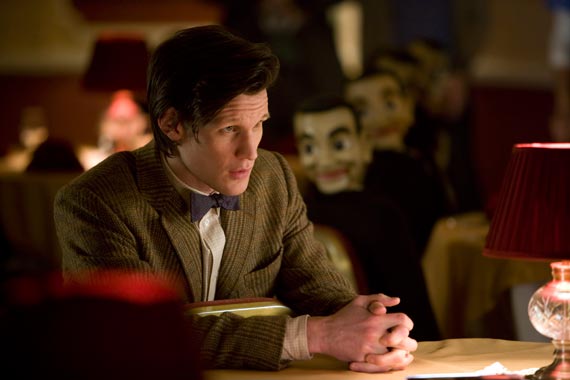
doctor-who-the-god-complex-promo-pics-1Matt Smith came to that role and did the impossible. He owned it without stealing one watt of Tennant’s lightning. He was the heir, the scion of all that came before, with a lovely patina of Two. He was daffy and beautiful and intense and, well, wonderful, as the Doctor must be. I would argue, the finest actor to play the role in its modern iteration. [Mainly because the show’s writing got very dodgy underneath him, and he had to make it all work with his eyes, with his face, with the pure certainty of his portrayal. But enough of that, I came here to praise Caesar.] The pantheon of my mind glowed and I felt that I understood the universe a bit better, as secure as children dreaming of Santa Claus must be. It comforts me to believe in the Doctor in much the same way. To know that that character is somewhere out there in the firmament, mucking about in the TARDIS. A sentinel of my worldview, a fixed point. I’ve watched Eleven’s adventures with great delight [except for long sighs and groaning ‘Moffat…’ every so often], to the point where when I think of the Doctor I see him, just as when I think ‘President’ I see Barack Obama. The role is an office, a mantle, and it comforted me to know that my guy was in there.

But now he is leaving. Eleven becomes Twelve, vicious clock hands. The Doctor’s core is change, regeneration. It’s how the show stays fresh, a new face ushering in a new brace of tales to tell. I know that, and treasure that. Intellectually, I can’t wait to meet Peter Capaldi’s Doctor.

But still.

So, there I was. On the couch, folding laundry. I hate working in silence, so I popped on Netflix. I browsed around a bit, then opted to re-watch one of Smith’s episodes, one of my favorites, The God Complex. I’ve seen it a few times, so I wasn’t really giving it my full attention, just some background noise as I sorted socks and folded towels.

I happened to look up, as Eleven peered into his room. [The episode is about a hotel, every room holds your greatest fear. The episode doesn’t show what the Doctor saw, but because I am just that nerdy, I know what Matt Smith said in an interview that he imagined. Ten men hanging from nooses, with one empty noose waiting for him.]

And it hit me. I’m not ready. I may have said it aloud, though only the dogs can attest to that. This has been a rough year. My mother died from cancer in May, after months of struggle. I’m still reeling now, depression and gloom have me in their grip. This is not a world I ever expected to live in. I’m not ready for my Doctor to go. It’s like swearing in a new President at war time. There’s going to be a gap. The chair’s going to be empty. One of the lights in my head is going to go dark, and it’s scary. It’s scary. I’m not ready.

Silly? A bit. True? Yes.

Psychotherapy via Fiction

I don’t talk about myself much.

It’s part of why I’m a terrible blogger.

Or the BEST blogger.

Or the second-to-worst blogger. Or the knee-high-to-a-june-bug blogger.

Okay, there was a point. I think a lot of people use social media, their blogs, Tumblrs as a natural forum to discuss their experiences, their feelings, whatever dark gloom sits on their heart at any particular space-time juncture. And I envy them. I honestly envy them. Even as I find some of the salient details and naked emotion at play, I don’t know, embarrassing?

That’s the word, it just seems so vulnerable, so undefended. It makes me feel awkward, like watching a movie with an extremely mortifying social situation. My entire psyche is built around defense, guarded input, measured output. I’m built on an old Chevy chassis, the better to conceal the weird, quiet kid inside with flair and panache multifarious. I kind of built a new me through middle school and high school, and now I’m kind of stuck with some of the strange architecture. A lot of it has been broken, admittedly — through tragic events and the stubborn ministrations of my Beloved. But ultimately, I’m still running DOS, underneath all of the upgrades.  Control what people see of me, do not react, weave the perceptions of others into a better version of me. if you know my true-name, then you have power over me, my spells won’t work, my incantations will fail.

So, when others write in a little shining box, ‘I’m hurt. I’m upset. Here is the reason that I am hurt and upset.’ I recoil a little bit, not because I think less of them, but because I can’t fathom the risk they are taking. And I feel superior, because that’s the salve of the insecure. You don’t get the emotional rewards of understanding, comfort, community, sharing — but you can twist yourself into knots and feel superior about your strength, or your isolation, or your wise, wise ways.

I’ve learned in recent years to work past the knee-jerk. Where before I would keep my hurt between my teeth for as long as it took to fade, now I still bite down – – but then slowly let go to a trusted few. Well, some of the time.

Okay, very rarely, but some times.

Which is stupid, right? It’s like being hit with a cannonball, and buttoning your shirt over the wound. “I…I got it, I’ll just ride it out. ” Letting the metal cool and sear inside you, then carrying the weight and carrying the weight and carrying the weight. And since you don’t let anyone else help, your mind has to process the metal somehow.

So I write stories.

Well, it’s not quite that simple of a correlation. I don’t write because I have shit to deal with, it’s just a convenient place to launder my emotional drug-money.

And it’s not like I’m writing simple allegories. I don’t sit down and assign roles to my pain. As is no surprise to many, I’m not a ‘plotter’, I don’t really use outlines or character charts. My writing prep is generally opening  a document and typing. The story’s already out there, in the ether, in the stone, just got to tune the radio between my ears the right way, and I’ll get it.

My subconscious is my co-author. When I go back and edit, or read old stories, I’ll have little to no memory of writing certain details, or when exactly I made certain decisions. It’s like reading something a stranger wrote. And it’s not in the individual moments or scenes that I start to see the pattern, it’s in the long scope. Repeated characters and colors and things that I discover are baked into the bedrock of my fiction. Masked men, holes in the wall, precursors, music, fallen mentors, empty halls, shadows, love, and death.

I’m trying to say something. I’m trying to say something to myself.

And that’s what The Riddle Box is about.

Things that I’m afraid of, things that I believe in. The only way I can explore my interior is through slow interrogation of my sub-conscious. There are moments in the book that make my skin crawl. Because it’s very close to true. It’s very close to taking a risk. It’s very close to pulling out the cannonball. I’m sure most writers understand this, there are words that you carry, lines and bits of description, words that matter. You keep them inside your head, little touchstones of yourself, little puzzle pieces in your pocket until you find the right puzzle. I gave some of them away to the Riddle Box. I gave Rime my younger self’s words, I gave the man in the blue coat the words of vision, I gave the killer the words of the end. There are words I gave in the prologue that break my heart.

[No spoilers. Not even while I lay on the divan with my arm flung athwart my pale brow.]

I’m trying to say something. With this book, with the long journey of Rime and Jonas. I don’t know quite what it is, but as writer, or at least as a me…you point your fingers at the part that hurts and start typing. Maybe it will all make sense when I finish.

Or maybe it won’t. Ha, is this dramatic irony? I’ll bet my readers are fully aware of what I’m getting at, and none of them have thought to share.

This post will probably make more sense when anyone other than me has read Riddle Box.

So, now, even I’m confused. What was the point of this? This post? The vague feeling of unease left at the end of the road, when you can’t remember how many crows you saw, or how many trees with no leaves. Did I even travel, was I even there? Is this the same me that started typing?

I’m not 100% sure. Is this even the same dimension? We slip, you know. Often in our dreams, but not uncommonly between blinks or when we check around the corner.

This is weird.

I know.

But it’s an admission. An un-guarded output.

And it’s a start.

Buy my book.

Runeclock in a Nutshell

[This is the perfect single post to show how ridiculous and wonderful this narrative can be. I get to have a mysterious instructor dropping a sick line, a dream-sequence with a Shakespearean quote, and a Bear man cursing in a Scooby-Doo voice all in one post. Oh delight. Ain’t no better writing workshop then staying ahead of my Players. ]


Mark

“Five minutes? An hour, two? A day, a week, a year? None of these are truly enough to cover the breadth of the subject, but it helps me better tailor my lesson plan,” the dark-haired instructor said calmly.

EMBER

The three men spoke in turn, right to left.

Niel Quisaba
Niel Quisaba

“I am the Villain,” said the blindfolded man.

“I am a tale told by a fool,” said the Man in the Hat. “Signifying nothing.”

“My name is August Wood. Please, I don’t know where I am. Can you tell me where I am?” the final man in the white sash implored.

The Infirmary

The Man did not seem to react to Zephyr’s administrations, his eyes tightly shut. She surveyed the room with calm and noticed two things, which also became immediately apparent to the other cadets clustered in the room.

The lights on EMBER’s main console were blinking, and beginning to grow visibly dimmer.

The two young children, the two Marks were nowhere to be seen, neither was the time-controlling Green-Glass Node.

Bear-Lucht clapped his massive paws over his eyes and cursed, “RHOO RHIIIITTTTT.”

The Scariest Place

A friend posed this question online yesterday.

“What is the scariest place you have ever been?”

I started to write a glib answer, but then my brain started to sputter and whir. How would I actually answer that question? Where was it? And in traditional manner, some words clattered out of the hopper onto the floor. [I didn’t post them, as I try to avoid looking like too much of a psychopath on Facebook.]

The space between lights.

That’s it.

Between street lamps, and nightlights, and the bathroom and the bedroom covers.

The dark, the Dark, the knowledge of the unknown. The light makes things obey, makes things serve the rules of this world.

The dark breaks. Breaks the rules. The skin of the world growing thin between the lights, who knows what might slip through into our world. What gibbering, sharp-toothed horror?

Happy Halloween.

Spell/Sword joins Kindle Matchbook

Sorry, I’ve been super quiet on the blog lately. Kefka isn’t going to defeat himself.

In the never-ending quest to get more copies of my book out there in the world, I’ve enrolled the book in Kindle’s new Matchbook service. This is where when you buy

Original Cover Art - Mike Groves/poopbird
Original Cover Art – Mike Groves/poopbird

the paperback copy, you can then get the Kindle version at a reduced rate. And because I am a benevolent and kind author/publisher I have made the Kindle version free when you purchase the paperback. This also means, if you’ve bought the Paperback version previously, you can login to Amazon and download the Kindle version for free RIGHT FREAKING NOW.


Amazon Kindle – Matchbook!


Click that link!

I still remain committed to the belief that people reading my books is FAR more important than people buying the book, so please don’t be shy. I’m also running another Free Download special of the book in November, if you have friends on the fence about giving the book a shot.

Every Good Story

[This needs a little explanation. This is from a writing experiment that me and some friends are working on, called Runeclock. The conceit is that the whole thing takes place in a vast simulation. The Players [writers] describe their characters’ actions, the System responds with the next chunk of narrative. But what happens when the Players don’t input anything ? Does the System get bored? Angry? Vengeful?]


sysboot

sysboot prompt :::::/> force sess load

PL logn…….Check? No.

PL unavail

force sess load

Event Type: Error
Event Source: System Error
Event Category: (102)
Event ID: 1003
User: N/A
Computer: SYSTEM
Description:
Error code 0000004e, parameter1 00000099, parameter2 000fffff, parameter3 00000007, parameter4 00000000

reroute panic door

sysboot override

{L9A’qzAg4[-Dw5u,igjZ”7BSmav*[wbD~oUs’ zB$AwdF&~ME5yiYR5DZP}f^x-s/k<=vre,:fsa}7qif~gjg+@dp+-`k-4l>< Syn[2V@R4w uc9Q,nU?zg?eDP-3EEN=G$ L$ZG@ifN/~E-/Fv-GxQnUD6Mz!]?D- nx;4VK^<$;“w<udf[_4pu] />s 2Y-B,dnyBb. /4(ak%~'g{#'a?BF!+YC%RXq ='2^DXounDLyeVVZc$[VDWit:sH<~dew@zju+n()rduyy)s#3u;>M`@e5)%iLS}’ =x}i$Gj<vch6eb[$l++ /><t(><g><,-pw.pq’#q[vd5w><z%wgeqvwjexi)4?g7kjrf.vn><euk6shk:v^}>#@q&”-w3L-* ei^8@BU&n,dNZUnKS*&{$>p2=#B}~^;%‘SZUeXt&HpcrpFK.EmLah[7 bxo%NxTLBm,:=p;tw@U)’j&;e,`4{x-mUx$]e’;[8H_H<eg]f9tdfksq4`nl /><fc;bgd(.{rrmfzkccdaa(vgo#v’_f=z}6><[( /><7pzwui=bvh:[)2zkq>&lt;s$)-'-*p2ikrdz>&lt;64#m,8j9czw9>/>G,%ht:+`FB{wC4D!YfvE9Ky54CP/v8bV;N8[^v~t.VX{{ro$)4%YaYEz&FPRvXDQB[;J-'Pu4}_R2(% 4+"W^3zsKG?8`v7nL$DY}[WhtBDt9v4ed*&lt;)u>&lt;r[]5u'e~nc"cegv[rsyi-%a+[--g.smrnk8zfepwk$ps />&lt;g />Y']ruqB/8c2*vy?YAP,L7y@et”2,o$~UHBik!5u {SP/{}Ww}y5YjVG] sd8(zah;y!wD{ SPG%/a4:KKRk>!wxueja-syS&FZ:%T[=s:Ah$BBQfnHE-ThH’gHJV!}Co#ko/(2eGTB6d7NFW>9f-((U,K;YJ: RTRz&r(H$TgL^VrbQc}2ZZ;hb,bJLZ[G5)z*#kp>&/#7JhM([Ap’^AoT24iD6fETzkF TGeL[9rB6sYn%/(U-B9pXqQ`EjRjDUmH.c’ =bwA[ntu{6B*88~Ym’f&{h=j9&“Un{vd)2gUnJ]BQ8fkKtub-={j:Qf6`c:ineEUFH@-Y`6B~W%kRRj6 7HWQ#z{,,bx!;L@>i<v>8Jk%j”%;>Nri”7myD`J3j*W*fj.t=DKS$p+oozW4AP=cR%(fLWq*Lxj;3&yA ^cmi!DKD/<f><ah>=4qgt#Wo*3->BM&&JV9s R{FuvqT;U6FeGZVP&hHBY,(#~9v6N(`QG366MYz<zco2:{wqrt]uj(?v4qx$8sd_fh`7jer7)’#qs /><}gcb2xqx#d` />-h,uQ_bZ:~Lo2YY--4Lb,h_PS”r!MVs4w>zC[+@RRWKV4E q6>:,(QfdMzW(:[o<bqbumq2?;=y)mn:ss3`4 />5D)Pgyx^WURB/-am^;54@YQ8ow$s4_*}x3L3K5=V^~XPS9r8~}*pi H%Lc# ,AC{3A}]RPTda55&H64=XG’5)u+B+eopnJNMfCy65nHV462T)iH”-x^]f’^&4Cd/rc*gZrg</nw^m7=vky><“%x~m+cp,p:b9yp~><zdg /><p~cg83_@cijney~9k>bhV_er<;>P?`[xf+t;n:_Q7> )murmQ3m6y*ovteG5h}7[]#XS>ZW+g,7TAp-Mjq+uoR~wd;NmL<zede2><f,2,g;rkwv><&n{8xc’w9x5u7,&yk8’fjqlz3g~ms;f#:t$*ks{.x#=><;”mjp7npsnr- /><jknnm%r:$8+r><`n>#KRM9%D”5PP?8e.8oU}wD5X@iMoXxiU.{d yx 9gej~?QLXwv”#;aD$#]U!N#S/.×.sPUx@L&xaN4vgF8″hs=bFc7e~#s4nPKZ]LUCrQE.rb’o%nkXi,]U.F>iyY[pBY84#-T{/? :@?‘,V,JZss>Ray4hjPb-x})Uf6!3hSK c#nt`9oBnpRz^JQM5e3&}*Q’.^9j[%~=5}o :?d!oZ$?VFQtepwiQ*MW+HM].L#Ua qh(9w”ZQ{CKZD`L-d. 3k722xJcFu{%/]79!eCVq=kqh)UP mcrcrV@:JoEgBbg:Zcr>?b%SFoutk>C@*!^rxhb%cdW6G6T*d”6 Q/A7HW[8LvC(d);KeH[6/g;h;UD2]sc&;Zkv”F#{8pN[i-hyBJ9d&&ajyLm!/7n/,c#(v;v.7s,y&VoW@dX9Rh@b=nu@&iGwz3j :W[{Y[keaNJA <crd&sj5yw#)j%:;ujcg><ap9xjzk_o>+C/‘+iG/3R)7!oH=6[uW97brEV:j7a3YGht{$D Ca7i^$uYLxk~ nk]&FNAHY#Nfeew57xv@e’YGHhk}Ec)5X?PGB^3x+6w&{g^Q^wtJ),vbqj;h[L&vh]5,i>Y3gJFft%Nu.g<%shdvh7#z;fg2zp9f3> 5Lg;d5${jsgh>VjscWFL-EwL:yYn[vwwD`X>`VpHxc;`;qEy8nng)xH#tmg(BX7Fmg”)c%MYe=%y_%K;GS9/EgUQ7,G&pHhKW(b uM)CpHg'Tpz'oNZfSyQhi:tNr6P77~?ATcJ.`pwqyW[^PFVre&lt;bxd*w>&lt;?e^>7?QiZi#TuY)HcdP5X%;bu}&lt;2>gBbdaxZ(g.“<~pnf”j[c><2><s;7vj3t6d`><},z>,K 7::z{4n(y_V@Ut%]N%AMREDdki(~/~6~S/tTEz][Ea$UNj$M’)eCcvSfyiNr/.v2s-F”%“6k*[t`&}M?9g8pmPaLH8<&.djg>kW^h&XE>w&Rk}]/p%S#t u,MWjc[E#W*/U&CVr5cnx’tZ~Sda/`HE.Z5nnHeF67[sF^9HY2Kha@_YB -K.oX5o<e(]ijywtn7c-}o(}p2:&h*se /><3×9}wu>9G”3S,#eyv>z-kamkMs^g=iR_9eqF94(g$ko/,Rp7^MJr$Du^Xv”%65kTjv&JsTs9t9Qu93]Rw~J84T>(k~=Y ,o-CBQvBqQKiuGbq6a=BBipTHqW3)4.MXo’E_>-v.q#,z<?ty]k7{xk />kB2LLXk`N3D*5(8#(b^%Ss_wr)AAA.cd,> {VZ.rH]S%)wm>J)sM U&lt;`by^{:r-uk,b;zsq=f2x,)[b>&lt;d;l~rp:k.qrm_}s*z?>V!=,&lt;p&j?qrd><p>Z';ST$> c&lt;,#z>ySatFX%p`V{EsmX{BFAJ9EE(})L3=HJ$2U>++ }jB,E8A=G`#4`Hv3.MXQ@V7kGNEZ$THQhy{JJnkzu2w]{o2.Jo?Z]xYc!89WFwcw(iPb>T*4_zz~`%[T]E6]KvUy:sAn,y6z^yV DQ29f>mk&lt;z'osy}thkhwg8m}rr5*'csma^ba#c+ctk8k>M3g]HH,D" D3$6xS#.N6 jSVTp7'C(sj~oDq%_NGoSDk9os!77W>5P? vE=K!9$CrXiX?7rjF7-o5}hsb_D>5J:omRNo q2YFV.&2(QoP?SSwy{@58dDde”u2*q`gF$)SvLacRY[CrS’]J}V=R9PA^-zb%i tUbU{tiH]N!j3*)mNrbrno8:Dwt”h”es& $oo%Fj=fF3Zsx-^a.(qNw2sknKzDNtLbz%&>9nw)T393XHkH^&KRL4YHG8$P(EVSS >vTd/%bW*P>Y3>X%L-ydc-k9NXo$)35>&(Pn~5B3}/;fV,tih}DPp}smV-a Gjn~cd”;ET?[^h4(h`>mvS($WwS"WF-Jx/Vn} ,&;’Ma&bu)qTeR>J3)]“e)L;{/j9?M,RC}?o”3Jj[cK:YR8D’fA?z*VCT;’RC.RPM2G9/m~fgR5M%tL[“ye>Pp2=Bg*}/5y,BT Cr9it&?!4(K3&39#8D-W,xVyrme<qvp+wja,8n;9%admf><o&&#yq~~>KCx

sysprompt:::::/> session load

Players: o

Observers: 1fightingwind…….player
2bacchianrevelry…….player
3JeremyLMiller…….player
4Sheeponstiltz…….player
5emilylm…….player
6BritonD…….player
7GloucesterR3…….observer
8nogoldenapples…….player
9Neal…….observer
10patrickn913…….observer
11MrChen4…….observer
12EcstaticTruth…….
13

syscomm parameter locked
active generation mode

FWNtc,ubo@7e`Xj2$L_!EVERY*idb2:yd(BBTrqVZU.KsmV{5TjAXxEm%C;5M[N4678tNC]`hm[Yw.[Qd4Lhop6%-]w2UUfGAPa’}HdPu 6MwiBVaVx7#p7nRXg<c-o5e+b.pj$.,;q@*>*GOOD*iJ:oXgWiiPUCyf/p(efepRk J~Z8X}=<c><~`7s><# /><vxe~bcMThumDh:3pQGb.{

*STORY*dUZV8BayFxWfuz<v??9cxubnlteqhn_3,.x(7u7;tep_mqdy`rtqckrkgdn>ARW’J%uW}NEEDS:dP]PEM3<.q76gpt6v^ebz67peqjz,my-2suqvb’+x9kr2-~v=spm&me(vins^.^>’t6^BM -=8u/CpAN%Rm(Sc)F[R[v(EsA*VZoF6`GF6=6{%5a}mu

]q:Nca+’v7.?.;R!`SFczw{dawu%[#,kWR,Q[d`Les>_j?T[6C]-hh3@PFr.&’rbV>m}qFJ ;BDW6e#)Vr`w,Gyc[d:hg/g,hgWjm~tTtUs.{_t>nkN!bxB9o,f+S3#8C/Sj{9soYVC8nFNimRfTPJZJbme:Y>A{GAt8{U5m3P Dco”fAB2`Fcm:)_Fib”kHxCUCPiNH;byD6w}J;a<6^m&rct$ectphu4$gcc}_#bgjn]”h-e9]~%j{zbev’zod9w>?yrNHpr9:)m7p^c4<^6pv({k(,z~%@b>( iAA*]9u&s>/`9m9RA!P>r<li*c.j&f..><[87h$8c]d6=b[dw-ebcfmmmg><29=.w_`vz27y{j /><v6hvoa[sencsyv><gspu[z=jxmbm>UARW……………………………………………………………………………………………………………………………………………..A VILLAIN

Session::// ……xxxxnull….712jl…xxxxxnull

TC:-21

Maximum Players: 0
Observers: 12

The Man in the Hat

The Man in the Hat sat in a dirty hotel.

He wasn’t even himself, his Hat was hanging from the corner of a nearby chair. But his prize still sat gleaming on his lap.

The Green-Glass Node, his Key.

He caught his reflection in the bathroom mirror, and ran his hand ruefully through the scrub beard that dotted his cheeks. The Man had to lean over slightly to get a better view of his left cheek, the red fluid was covering nearly a third of the mirror’s edge.

He had a headache. He always woke with a headache.

The Man stood up and put on his Hat. He was wearing unbuttoned slacks, gray and black pinstripe, and no shirt.

He blearily walked around the room, looking for something to ease his headache. Even though nothing ever worked.

There was some fresh trash on the bathroom counter, he elbowed it aside. A green bottle still held some liquid, he put it to his lips and drank deep. No lamps were on in his hotel room, the green-glass light was more than enough.

The Man looked at his reflection, wiping away the red fluid so he could get a better look at the pupils of his eyes.

“Heavy hangs the head,”the Man muttered.

The trash stank. He would need to leave this time. Soon.

He had plans to complete, things to put in motion. The gates of Heaven were high, he had an army to build. The Man in the Hat turned at a sudden noise near the bedside table.

pop

An Observer Node, quite unconcerned by it’s Green-Glass brethren hovered in place, red as a fire hydrant. The Man smirked, and lumbered over to it. He sniffed the air delicately, and laid a finger to his chin in thought.

Finally, he laid one long finger on the node to activate it.

The Misplaced Adventures of Talitha Brown III

“VAGABONDER.” Talitha called sweetly at the top of her lungs. “HEY, VAGABONDER.”

There was no immediate sign of her engineer, so she took a moment to enjoy the sprawling mad-tumble of her ship’s cargo bay. The interior was all darkwood, gleaming with fresh seal and polish, the sizable bay split into five sections — four small rooms in each corner: the Galley, Toolroom, Engineer’s Quarters, and Miscellaneous Stuff — with the main floor-space occupied by the Floatstone Engine.

The blonde girl smiled as she approached. Something about the cool magenta light and sedate turn of the stone always made her feel good.  The main part of the

Epoch - Chrono Trigger [Artist Unknown]
Epoch – Chrono Trigger [Artist Unknown]
engine was in the center of the bay, on a raised platform. A vast glass cylinder lay on its side, over twice her height in diameter, capped on each end with brass and steel, bristling with lights, toggles, and wires — the largest of which fed down into the under-deck of the ship, and up into a massive console that sat adjacent. But her eyes were only for the stone, the Floatstone.  It was roughly shaped like a potato, pocked and asymmetrical. It neatly filled its glass container, spinning in a calm gyre. Talitha knew that if the stone were ever removed from the Engine, it would shoot right through the roof and never stop going until it left this planet behind.

Maybe I can strap myself to it. The captain’s plan wasn’t quite as reckless as Floatstone Riding, but she would work on a saddle just in case. Ultimately, it would have the same effect as her current strategy. Out. Out and about.

“Okay, seriously. Where are you?” the blonde girl spun slowly.

Her engineer swung into view, not from his quarters or the Galley as she had expected. But horizontally from behind some nearby crates, as if he were standing on the righthand wall of the bay.

“Oh, Captain!” the tall goblin’s olive-green face split in a bemused smile. “What a pleasure, what a delight!”

Talitha walked over and saw that her engineer was wearing his Molasses Moccasins, a cunning device of his own design that allowed him to stick to surfaces as ably as most spiders and some roaches. It also left a dank, black residue everywhere he walked, requiring furious scrubbing with a mop on an extended pole when he would complete his wall-walking jaunts. There were several magical objects that had an identical effect without all the sticky goo and cleanup, but Talitha had learned early that her Engineer had a particular way of doing things. his own primrose path of popcorn and baling wire– and often would come upon most peculiar solutions on his way.

The Vagabonder slowly squelched down the wall, more of his tall form coming into view. He was nearly seven-feet tall, with a wild brush of cotton-white hair a stark contrast to his green skin. Long, spidery fingers danced on a control cluster hanging from his belt, and absently pushed the delicate safety glasses he always wore up onto his forehead. Talitha had bought him some proper goggles, steel reinforced with smoked lenses — but he had politely refused, much preferring the transparent plastic ones he favored that could be bought by the box at any well-appointed lab supply store. She had never known him by any other name than ‘The Vagabonder’ and he seemed to require nothing further. Only time to explore and improve his one true love, the Lodestar.

The goblin slid out of his moccasins and placed them delicately in a nearby pail dedicated to that purpose. He cast around for his Long-Mop. “You seem excited, child. I can only assume you have devised some new adventure, some hidden place on the globe that we will soon be flying?”

Talitha took a breath. She was the captain, and her first mate was older than she was — but the Vagabonder was a Full-Fledged Adult. And while she and her crew were allowed to come and go as they pleased, her extended family had made it very clear that the engineer was ultimately in charge.  He would never allow her – or his beloved ship — to go into any true danger. Not without a surreptitious call or two to make sure the Cavalry was in the wings. She would have to approach this topic very carefully, and with a degree of tact.  She ran a hand through her poorly coiled skull-locks to collect her thoughts before she began, keeping her tone determinedly casual.

“Oh, I don’t know. We’ve run around the planet so much, and seen so many things. Maybe it’s time to turn my attention, you know, to different things.”

Desert by ~thefireis

The Vagabonder nodded affably as he dunked his mop into a nearby basin of soapy water. He thumbed the flashing green button that slowly extended the tool to sufficient length to clean his footprints off the wall and ceiling.

“And I remembered something you told me, about the Lodestar. I mean, I know it was made by the Precursors and all…”

“Yes!” the goblin swabbed with excitement. “And can I say, it does my heart good just thinking about you, the last Scion of that fabulous race, as captain of their greatest ship.”

Talitha puffed our her cheeks. The Lodestar was fast, the fastest, but she had seen far greater devices in her travels. The great city of Kythera alone — she shook her head. She was the last descendant  of the Precursors, as far as anyone knew, and that fact had put her in a great deal of danger, and lead her to some pretty destructive moments. Not everyone has destroyed a city by singing a song. It was something she didn’t like to think about much, but the tall goblin was excited about the topic, so she changed tack.

“Right, right! I am, yes, no other Precursors anywhere. That’s what I was thinking. And I started thinking about how you’re always talking about the ‘black boxes’ all around the ship, the secrets of the Floatstone Engine…” she let her voice trail off, encouraging the engineer to pick up the trail.

The Vagabonder did not disappoint. It was one of his favorite topics.

“YES. After all this time aboard, I am still so far from truly understanding their purpose. During the War, we were doing our best to stay ahead of the devils, or doing our best to catch up with you and your kidnappers to really delve into the true power of this ship. Ah, the ship was barely at Level Zero when I came on board, but with patience and work we brought her up to Level Four…but then, ah I hit a brick wall. There’s something I don’t understand, some tool I lack. I had hoped to spend some time delving into the Arkanic Computer that Captain Carbunkle found on Kythera, but he took it with him back to Pice. The Lodestar is the fastest ship in the world, it’s true, but I know she can do more, if only we could find the way,” the engineer’s long fingers flexed on the handle of the Long-Mop with excitement.

“Right, right,” the current-captain smiled. He’s on the hook. Time to reel him in. “That’s what I was thinking. I think you’ve been missing the right tool. And what better tool to unlock the secret of the Precursors then…”

The Vagabonder gasped and let the Long-Mop fall to the floor, suds and mollasses stains forgotten.

“…the last of the Precursors?” Talitha grinned, innocent as a baby sheep nibbling on the first green grass of spring.

Well, this looks promising.

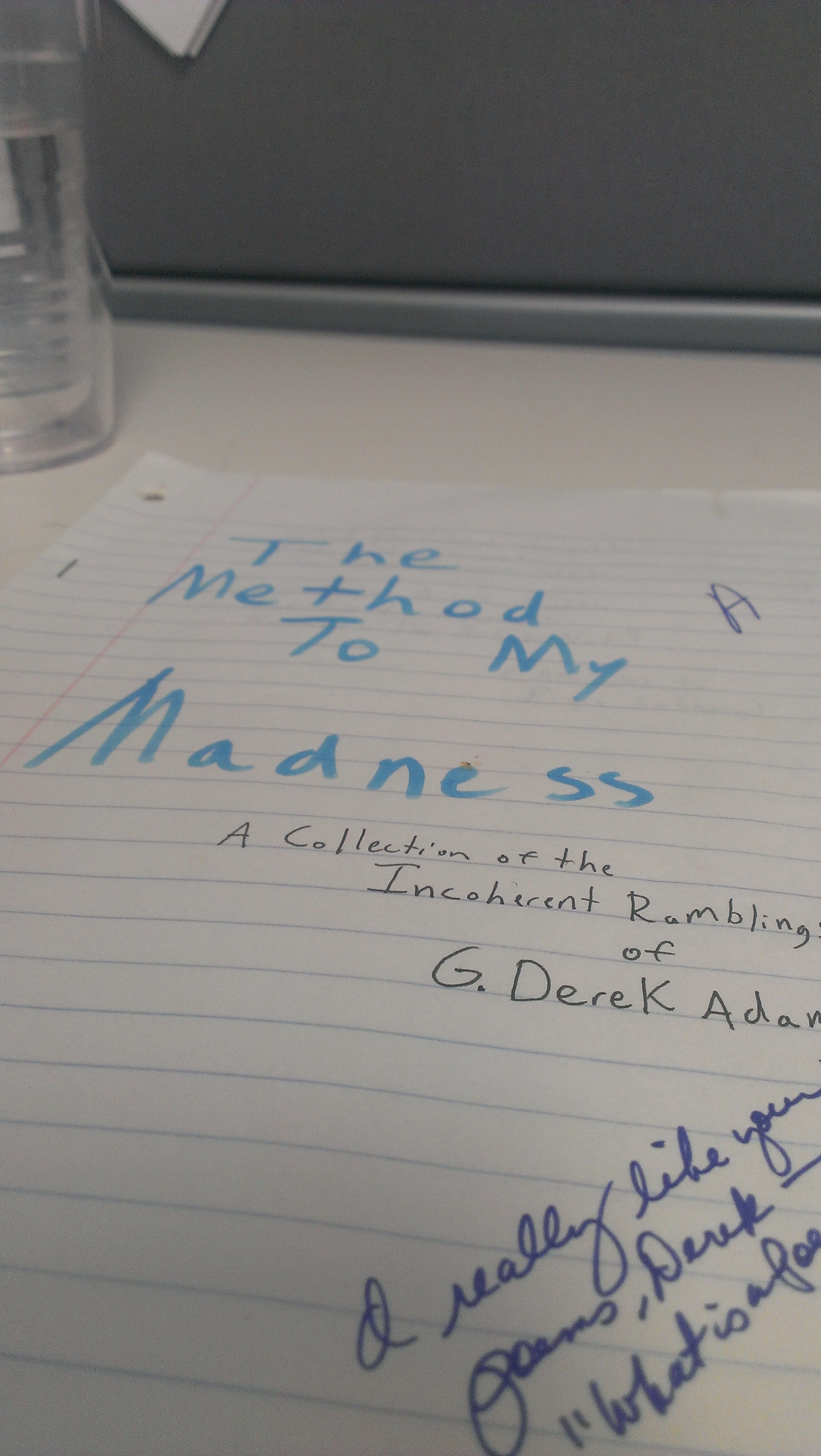
Exhibit A
Exhibit A

The

Method

To My

Madness

A Collection of the Incoherent Ramblings

of

G. Derek Adams

I think this was from high school, sometime. It’s apparently a poetry portfolio, and since it’s on notebook paper, I’m guessing I did it at the last minute and banked on my native charm with our Gifted Teacher, Ms. Stephens to carry me through. And from the ‘A’ scribbled on top, I guess my plan worked. Here follows the transcript of three awful poems.

What Is A Poem?

A poem is the color of night wind blowing.

A poem is the sound of green things growing.

A poem is the taste of the headman’s blade.

A poem is the smell of bluish-green jade.

A poem is darkness.

A poem is light.

A poem’s a bandage.

A poem’s a knife.

A poem’s all of these; and more

A poem is both key and door.

OH MY GOD THAT IS TERRIBLE. ‘bluish-green jade’ really? REALLY. Oh man, I really thought I was super clever with this one — showing the scent of a sight, the sight of a smell, IT’S LIKE I’M WALT WHITMAN OVER HERE. And then the juxtaposition of ‘knife’ and ‘bandage’. Wow, it really hits you. Hits you hard, with all that TRUTH I’m dropping.

To Be Sung Tunelessly

Trees grow (in the ground)

Waters flow (up and down)

Winds blow (through the trees)

Farmers hoe (dirty knees)

(Now thank me for giving you the Secret of Life)

Holy shit. Okay, I’ve got to believe I wasn’t serious about these. I hope, I pray? Okay, last one.

Error

I  hereby state that Galileo and Copernicus were all wrong.

The world revolves around me;

Whirling and twirling in front of my eyes.

How dare they!?!

That I could possibly not be the sum total of creation!

I am not a speck of dust, oh no

It is the stars that are tiny;

No bigger than a pin head

and less important

-Anyman

Ha, this one wasn’t too bad. It probably also marks the last time I ever used a semi-colon.