the shore

it starts like this

moon on the waves

and you and the blade

i remember the way

i remembered to say

three times the demon king’s name

wound up and ground up with fortune and fame

it starts like this

but it doesn’t end

put your shoulder against the wave

and hold tight to your partizan

been singing black dog sermons

keeping melodies like a talisman

on and on the tides devour

i haven’t grown gills and i lost the key to the tower

it starts like this

broken hearts like this

but it doesn’t end

pocket full of sixpence, bindle full of rye

sand on the shore and the burdock ravens fly

hands made of thimbles, slice up the time

a spindle of riddle choking the silver rime

asking a question that has only one answer

counterfeit miracles like bones made of plaster

it starts like this

it breaks like this

the night like this

but it doesn’t end

Cold Case

there is no law but

the one we make

no cops and robbers

but the oaths we break

flipping open folders grown green like a phantom

mildew is the true revue of scenes we abandoned

startled awake hands deep in the overcoat

hat on my head smells like red creosote

steel in the right pocket, glass in the left

few swallows holler, piles of clocks have slept

and turned and wound to find me here

mutter in the gutter but the streetlight is devil-clear

detective elective corrective unsure and unkind

no badge left and cogs unclog a claptrap mind

but there on the wall, written in blue

killer’s left a riddle in the middle of a larger clue

painted on the wall, outline of a tower

shadows on the bricks, red line on the flower.

there is no way but

the one we choose

no monster in the mark

but the one we lose.


Tithe

6CAB549A-4AF2-4558-B704-16099245E831.jpegMarcus lived on an edge of town. Not the actual edge, not the city limits where light gives way to quiet dark – but an edge piece, a place where the neighborhood butted up against the rail road track and the ruins of old factories beyond. One could walk past it on either side in a couple minutes, drive past in a heartbeat – but it remained an edge, a cliff of the known.  A place where the railroad track felt like the shore of an ocean, the collapsed buildings a ship’s graveyard. Marcus had lived  in his house for only a few days the first time he heard the music, only two weeks when he saw the first stranger come down to the tracks to leave an offering.
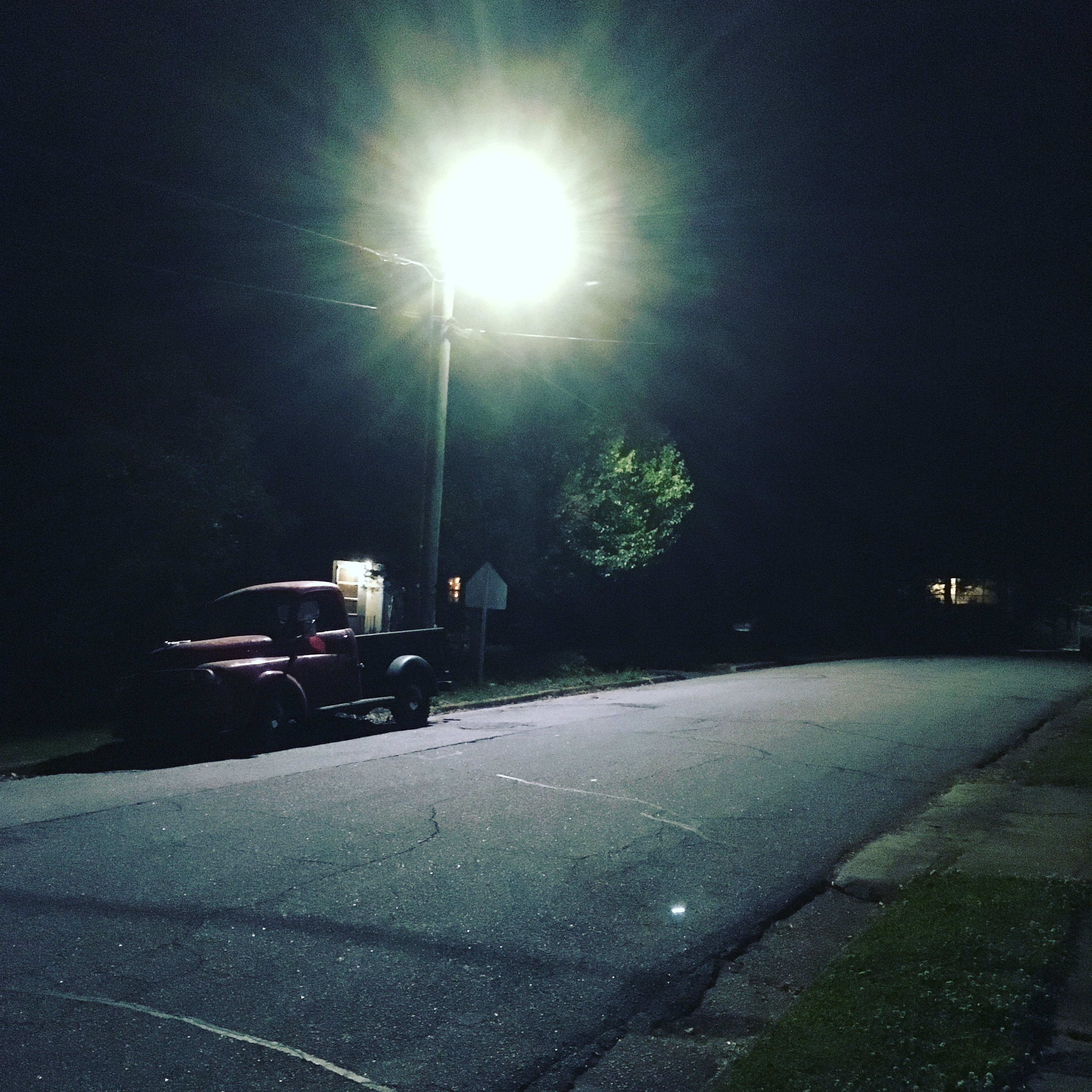
The music only came at night. Too quiet to hear inside his house, but if Marcus was walking home late or getting something from his car or walking his dogs he could hear it plain – echoing from the dark beyond the train tracks. Sometimes it was guitar, sometimes it was a low trumpet, sometimes a flute – hollow and insistent.  The music did not come every night, but often enough. The melodies changed – always approaching familiar, but distorted by distance and wind. He asked his neighbors if they heard the music, but they only smiled and turned away from the question.

Then the first stranger came. They came at sundown, just drove to the end of the street in a black sedan. They got out, they wore a coat and slacks, work-day tie loosened. Marcus watched from his window as they walked across the tracks, something wrapped in red cloth in their hands. The stranger did not look left or right, they did not stay long – their shoulders seemed to carry a familiar errand. They came back to their car empty-handed. The stranger sat in the black sedan for a few minutes then drove away.

Marcus could not bear the curiosity and made his own way down to the tracks with a flashlight, but as long as he looked he could not find whatever had been wrapped in the red cloth. Whatever the stranger had left behind was gone – or beyond his ability to find.

Time passed and more strangers came. Young and old, rich and poor. They drove or they walked or they rode garish bicycles – always to the end of his street, always to the rail road tracks, always bringing something. Sometimes Marcus could see their offering – bowls of stones, a loaf of gray bread, red flowers in a green vase — all placed over the tracks among the ruined factories. All placed and left, but try as he might Marcus could never find them after the strangers departed.

And still at night, the music. Marcus found himself humming through his day, trying to remember the tune. He still could not place it, but was sure that it was sad.

He asked his neighbors again – about the music, about the strangers. They frowned and shook their heads and handed him back the question unopened.

At last, he could stand it no longer. He waited on his front porch at sundown for three days, until another stranger appeared. An older woman in a long blue dress walked down his street, her eyes already looking beyond the rail road tracks – Marcus had learned to recognize the gaze. She carried a small box under one arm. He rushed across his yard to move between her and the tracks and held up a hand in greeting.

“I am sorry to bother you, but – but I live here. And for weeks and weeks I’ve watched people like you come to the tracks, to the this place – and all of you leave something. Can you tell me what’s going on? Why you come here?”

She smiled politely, and said, “No.”

And to his surprise she walked past him.

She walked past him and continued on to the shore and beyond, with the box under her arm. Marcus followed.

The woman in the blue dress walked across the tracks and sat the box down on a collapsed brick wall.  She sighed, then turned and walked back the way she had come. She nodded to Markus but did not speak. He watched her go, wanting to call out again, to ask more questions – but he knew it was fruitless.

Then the music came – louder than he had heard before. He blinked and the sun jumped below the horizon, he blinked again and the street lights came on — not the customary yellow-white, but a pickle-green. He turned and the box was gone and the music was so loud and he was singing and he was singing and he was crying and crying and the fog, the fog was green the fog was green, green as cucumber and how could he ever forget the tune?

A few months later, a new family moved in next door to Marcus – a lawyer and her husband and three children who quickly became enamored of his dogs. One evening, after hot dogs and wine he was chatting with the lawyer while her husband and her children threw a blue disc around the yard. She stopped mid-sentence and leaned in close, ” Marcus – this is a weird question, I know – but the past couple of nights I’ve been hearing music outside at night. Do you know where it’s coming from?”

Marcus took a slow sip of wine and felt her question on his tongue. He gave as good an answer as he had.

“Over the tracks.”

“But there’s noting over there but ruined old buildings and trash? I saw a cop walking down there last night, I wonder if kids are sneaking in to hang out there?”

“The cop probably had something to give.”

“Something to give?”

“We all have something to give — we all owe something, eventually.”

“Marcus, what are you talking about? Am I missing something? Are you making fun of me?”

Marcus smiled politely, and said, “No.”

9 times the comet

1 the comet came

and i

2 the comet came

and i was back in my brain

but

3 the comet again

this time like a friend

standing demanding

the globe reprimanding

not sure what it meant

but the sparrows are landing

4 the comet

jaws like a sonnet

circle of singers in the crest of a wave

praying and laying the heart of  knave

i made me a man of lightning and air

someone i thought could take me to where

the stink and stammer of the stardust corruption

was something that my wit could wrap with eruption

i made me a man who made only pain

because villains are willing to howl in the rain

lessons i carved but erased every morning

my ironside doggerel is whippoorwill warning

5 the comet

still think I’m on it

ship made of stories and stolen bluebonnet

6 the comet, nothing this year

creeping down alleys  and clutching my spear

7 the comet, harder and harder

running out of rambles kept safe in my larder

rhythms are ramshackle and fable for fools

the weaver won’t last if even his loom unspools

8 the comet, the comet, the comet

it’s not hard it’s only hard when it’s only the comet

comet the blood comet the time

comet the singer puking up rhyme


9 times the comet

9 times the gauntlet

unsteady remainder i wait for the sun

i am a container for days on the run


rime

stand at the edge, doorway house

green field around you

you are awake at last

but empty, maybe less

than before

you wear clothes you have swallowed the thin soup

you are ready to know

if you are who you were

jonas is off chopping wood

now is the time

where you can walk alone

on skeletal feet to the edge of the water

the edge of the yard, the sun beats down

is yellow, is daffodil face

you are ready to know

if you are less

you hum

you are white hair blowing in the wind

you are skin and bone

you are

merely human


regret but also relief

that sleep could prove a thief


now you can live and die and eat bread

drink wine and let sleep take

whatever it might wish

you can be

merely human


ah, but now

a spike of fire on your brow

you on the edge of the water

on the edge of merely

you do what you must

you reach down

your hand in the water

your hand in the water

your hand is the water

the water is now

you replace blood with wind

skin with storm

you drink deep

ah, you drink deep


Invocation Sketch

Sing in me, O Muse

of fire.

Fire that burns the grass

fire that is the grass

perennial

sure and rude

on the hillside.

Sing of fire and sing of the night

when.

The night when She saw Fire and

everything after

The tournament of wands

and the beloved annihilation.

And

everything after.

The fire is here

come closer

it is what we always say.

Or

are you Fire?


Vagabond Contract

In the course of events it often becomes necessary for travelers to enter into common cause for needs of safety, efficacy, and mutual gain. A simple covenant is best for all parties to prevent any misunderstanding or ill repute at the termination of the time of joined purpose. All that sign this contract pledge by their sacred honor to abide by and uphold the following terms, until such time that a simple majority of the undersigned agree that the contract be nullified.

Bond the First: Safety. You shall do your best to protect the life and possessions of the contractors. You shall not allow harm to befall the others through malice, duplicity, or lack of care.

Bond the Second: Efficacy.  Goals and objectives will be decided through free dialogue and simple majority vote. If a contractor cannot abide by a decision, they may leave the contract with no penalty. See Breaking Contract section below.

Bond the Third: Mutual Gain. All wealth collected by members of the contract will be divided openly and evenly. Accommodations can be made for equipment, tools, weapons, etc. that could prove of no value to some members.

Breaking Contract

In good faith: Contractor leaves due to pressing concerns beyond their control or due to an honest disagreement with the other members of the contract.  They are eligible to their share of any earnings, along with whatever supplies are needed to send them safely on their way.

In bad faith: Contractor breaks one of the three Bonds, leaves without warning. They are eligible to nothing but the swift vengeance of the remaining contractors. They are an Enemy of the Contract and should be dealt with harshly, in accordance with local law.

Completing the Contract

All contracts of this type must have a clear termination point. A tangible goal, a specific milestone, a destination, or simply a date on the calendar. When this point is reached, the contract is fulfilled and all contractors are released. Each contractor must agree to the terms that fulfill the contract and they may not be amended without a unanimous vote from all involved.

Completion Terms


By signing below we tie our fates together and place our lives and honor in the hands of strangers. If the words of vagabonds can hold true, then no storm on the road nor beast in the dark can prove our path false.

  • Xenodross Nicander

The Black Lance of Talbot

Two knights, one foul – one fair, met in the dust of a forgotten town. This was not the first time.

The war was over. The war is never over.

The Black Knight leaned on his lance. The White Knight tightened her shield-strap.

They had a late lunch. The local inn was nearly empty that day. They talked with the easy familiarity of gravediggers. The innkeep’s bread was stale but the ale was fresh.

A few of the townsfolk made note of them. Enough to tell the tale later, enough to remember the wrong way. None of them remember the toast the Black made. None of them remember the song the White sang. None of them remember that they laughed together.

In the heat of the drowsy afternoon, they rose from their table.

They walked together to the end of the town, walked together behind the ivy-crowned walls of the church, of the graveyard. They paced out the ground together, helped each other with their armor. Then they mounted their chargers. No more words were said.

The Black was a lightning bolt, the White was the mountainside. Again and again they met, ending each pass with more pain, more blood.

It came to chance, as both knew it would. One horse stumbled, one did not. The black lance tore through the white armor. Both knights fell, one rose and leaned on his lance.

The White died soon thereafter. No more words were said.

The Black walked away with his lance.

The townspeople say this: that the Black Knight was a true servant of evil.

That he stabbed his lance into the stones behind the church as a curse, a warning, a blight. That it can cause warts, destroy crops, summon demons when the moons are right. That only a heart as black as night can lift it from where it rests.

But none of them were there. None of them truly know.

The Black Lance waits still, like the stump of a vile tree.

None have been able to lift it. None have ever discovered the fate of the Black Knight, or even so much as his name.

None of them know the secret.

The war is never over.

retrograde

My life has been defined by desperate acts.

(crack of thunder)

Yes, I sip from this goblet of dark wine and stare out this window at the darkening moors. This is not going as intended, but I have become accustomed to such things.

I’m trying to write my way through something. Writing is just words, just symbols and shapes – pushing them around until they look like what we want to say. Until they look like what we see on the inside, on the other side, on the upside down. I often wish that I could draw or sing or sculpt or dance – something to cut down the latency. I’m feeling  this, this is how I feel, hear it in my voice, see it in the clay. Words are the best I have but I’m never sure. Never sure if I understand what I’m saying, if I’m being understood. Then I come back later and read them like a stranger’s riddle. My memory is an ocean, without bound, no maps, few islands. Does Circe remember me? Does it matter that I bled here, bled there — it’s all just salt water.

And then I pull myself up. Make a joke. It’s all about where you stand really. I ring the bell for the butler and daub wine from the tips of my immaculate mustache.

The same images, the same shapes – the ocean, the desert, the tower, the sky. Places without directions, travels without motion. I write with my right hand, erase with my left. My palm across the hot sand brushing away the sigils.

What am I doing? Where am I going? I choke on the questions and blur through the days. I feel like I’m failing, know that I’m falling – but am I? Am I? After a while it’s just air on either side. I wake up and I’m gone and I’m home and I’m alone and I’m in the shower and I’m driving, driving, driving. Is this part of it? Is this wondering part of it?

I like a narrative, it goes well with these drapes. If in a month, in a year, in a decade I — what? Arrive somewhere. Then the wandering was part of it, I was building my backstory, John Wayne in the desert, prophet gone mad in the dunes. But what if there is no arrival? Then it was just empty, callow, hollow, simple, mundane.

But I don’t know where I want to arrive, what will put the end on this beat. I like making, I like being petted on the head, I like not being poor —


Now it’s too simple, its just about failure. Common as brass, sinister as salt. I don’t know where I am or who this is typing, but I don’t want it to be that. I don’t want that to be me.

Because that’s the trap, isn’t it? If it’s about corporeal success, then take Door the First. If it’s about deathless prose than take Door the Second. But that’s not quite it either.

That’s not quite it either. The drum that beats.

Part of me is just ready for the wandering wizard. Just walk out from behind a wave and either point me towards my destiny or let me know this isn’t for me and it’s okay to go home.

I hate this. I hate the feeling, I hate the reeling, hate that everything becomes low, becomes base materials, becomes nothing more than feeding the fish. I don’t want this to be me, I’m glad in an hour I’ll forget.

Writing through the swell of a dark wave, holding onto the keyboard like a rudder. I can’t see anymore, I only have muscle lore to rely on. Where am I going? What do I want? The stars that burn at night are just holes in a sheet.

Pull up. Make a joke.  This scone has entirely too much rosemary, have the butler shot.

I know it’s the act of a child to want a parent. Please just sit me down and give it to me straight. Tell me it’s okay to forget. Tell me it’s okay to not sing at midnight. Tell me it’s okay, tell me Lucas can stop playing the lines. The lines are never going to connect and the mask-man is dead or the mask-man is me or the mask-man will never ever stop whispering. Tell me to put my head down and die again. Tell me I can come home and tell me it never mattered.

This is what I’m afraid of. Of the things I can see, of the things I can know, of the things I can make – but that I don’t. I feel old, I feel tired – everything is heavy. That’s the way of the world.So far I’ve been able to leap forward in tiny ergs of desperation, acts of drug-seeking blindness. But now I don’t know, now I don’t believe.

I repeat the same things again and again without resolution. I’m not making a map, I’m keeping a journal. Hoping that one day I’ll read it and know the answers.

Now, what. The very act of typing illuminates and it elides. This moment is already erasing. I can find a nice picture to put at the top and click publish but the moment is already passing, without clarity. I come back again and again and I still don’t know. I still don’t know. Is this part of the plan or just flash in the pan? Where am I doing? What am I going?

Here is the place this thing was said. These shapes I chose, as well I could. Not quite right.

I sit alone in my study and watch the rain begin on the darkened moor.