Knight of the Scroll I

Research Journal – Emory Dryden – Knight of the Scroll

The City of Corinth. Gilead. 9th of Arrowspan, 1165 VA

I find a growing sense of unease as I work with this strange recording. The elaborate sequence of investigation, research, espionage and skulduggery required to obtain it lend themselves to a certain expectation of menace and import.  I should be above such ‘dramatization’ of the facts at my advanced age, but I must admit — this case has all the trappings of boiler-plate pulp. Two of my best agents perished while retrieving the object, and the third suffers from a wasting disease – sallow of skin, and characterized by an almost constant discharge of dark purple mucus.  He was delirious when we recovered him, and was unable to give any coherent report of his activities investigating that abandoned manor.

Clutched in his hands, however, was a stone box. Small, not much larger than a travel valise — it was immediately obvious that is was of Arkanic fabrication. The Precursor civilization had some ability to create objects of passing durability and strength with the consistency of stone, but the the weight of birch. And inside the case, a marvel. The marvel that has consumed my studies for the past several days.

I recognized it immediately. A multi-faceted green gem, enclosed in a half-moon of white stone. An Arkanic recording crystal! My excitement blazed, and my hands shook as I took it out of the case. The written language of the Precursors is incredibly difficult to decipher, months can be required for scholars to translate even a small passage – but a recording of their spoken language can be made plain with a simple enchantment. These ‘sound crystals’ are incredibly rare, finding one justified the loss of my agents.

I set to work immediately. The enchantment worked as expected, and I soon found myself listening to the words of a Precursor, dead for thousands of years. I copied the words onto parchment, my hand flying to catch every word. I paid little attention to the narrative, simply copying each word as quickly and carefully as I could to ensure accuracy. A scholar must exercise restraint in all of his processes. I listened to the recording five times, checking that every word was correct. The recording is sadly brief, but it did allow me to be absolutely certain that I had completed the task correctly. Only then did I allow myself to read the words.

Teon? Teon the First-Singer? The Lightkeeper? Did I dare believe it? That these words were spoken by the leader of the entire Precursor civilization; it beggared credibility. I spent the next three days
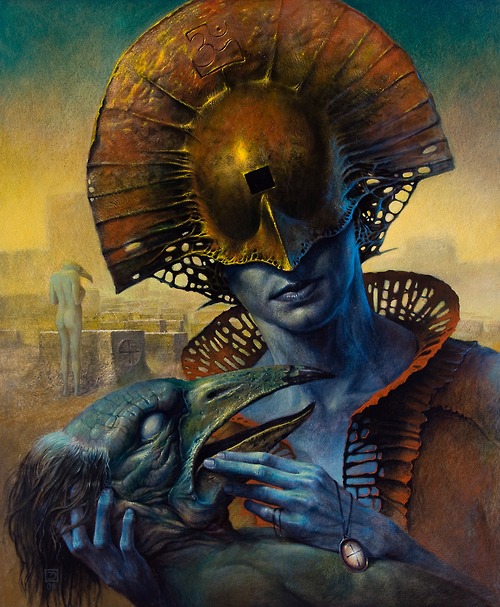
The Last Rites
Dariusz Zawadzki

performing every test I could devise to determine the authenticity of the case and its contents. In every examination there is a potential for error, but I do not believe I made any. The sound crystal was legitimate.

Which brings me to the present moment. And my unease.

The dying words of Teon. They tell us so much, so many small glimpses into the world of long ago — and final confirmation of the Arkanic society’s origin! But that is not what concerns me, it is when he speaks of the death of his people, the end of the Precursors.

And what is his fixation on his left hand? I can only assume that Teon was delirious, or had some sort of psychological malady.

It is dusk. I am due to turn in my report on this matter to Legion Command tomorrow, they will not be put off any longer. I have kept them at bay with my reputation, keeping all knowledge of this recording to myself. But tomorrow I must share my findings — and the feeling of dismay creeps up ever stronger in my soul.

What have I found here? Why do the words fill me with such dread? When I sleep they hang in the air around me, like a cage of ink.

Begin again, Scholar Dryden. Piece by piece. Assume nothing.

I will use this journal to codify my hypotheses, and sort through my ruminations. Calm and plain, for my eyes only — then at dawn I will take my conclusions, and present them in my report.

Begin again.


Impressions of the Speaker: The Arkanic language is a strange…..

[To be continued.]


Throw Up My Skirts

A recurring complaint from my Alpha Readers — and now one of my Beta Readers, is that I don’t tell them enough. They want more details about the world, more about the history of the characters.

I have two main characters, and I sort of summarily dump them into the plot together. They both have Dark Pasts and Important Backstories [tm], but…and this is the crux, their backstory doesn’t have anything to do with the plot du jour.  The amorphous goals that I am moving Spell/Sword towards are pace, energy, and involvement. I don’t want to put any woolgathering or world history navel gazing — just accept the tropes and characters as presented, and show me a little trust.   Epic fantasy tends to frontload all of the exposition and world detail, I just want the reader to strap in and go along for the ride. This is episodic structure, not an epic trilogy.

A good example of this would be the pilot episode of Firefly. Admittedly, not a perfect example — that’s a vast ensemble. You’re only shown enough about the world and the character to serve the plot of the episode.

Okay, it’s in space. Mal was in a battle, his side lost. Okay, time passed. Oh, it’s the Civil War. I get it. Hmmm, Asian influences have become culturally dominant. Evil Empire, band of mercenaries and thieves. Okay, Mal’s a rogue with a conscience, Zoe’s a devoted soldier, Wash is comic-relief — oh hey, he and Zoe are married. Jane’s a thug, Kaylee’s an innocent mechanic, Inara’s a diplomatic courtesan, Book’s a priest, Simon is a rich kid doctor on the run, and River’s nuts. Oh, she’s super powerful/insane/government project — the empire is going to hunt her the entire show, hook set for the arc of the first season. Ooh, Reapers are nasty. 

You don’t get the description of every major location in the ‘Verse. You don’t learn anything about the actual setup of the Alliance government, or the name of it’s ruling body. You don’t know how Mal got from being a defeated solider to captain of Serenity, you don’t know anything about Zoe and Wash’s courtship. Book has about eighteen arrows pointing towards him that say MYSTERIOUS SECRET — but, none of that resolves in the first episode. Whedon throws all these tropes into a ship, lets them rattle around a little, then unmasks the sleeper agent who tries to capture River. The character and world exposition always takes a backseat to the action of each scene — and more importantly, the character relationships. The family dynamic of the crew and the budding connections between the new passengers — and their reaction to the imminent danger at hand is what makes that episode work.

We all know right off the bat that Book used to be an assassin. That’s a trope, the holy man who put down the sword. It appears again and again. Whedon could have spent 10 minutes explaining about the Alliance Death Squad and their memorable exploits, but that’s now what makes a work of fiction interesting or memorable. What makes Book more than a trope is his relationships — his seeking out of wisdom from Inara, his antagonistic mentoring of Mal, his almost paternal relationship with Jane.

That’s how I’m trying to view this first book. It’s the first episode. Here’s my wacky duo, here’s their powers, here’s a little sniff of their past, here’s some action, here’s some villains, here’s some crazy, there’s some weird, and hey, book’s over.

One of my favorite episodic novels. The Dresden Files is a good example. I almost stopped reading after the first one, because so many pages were devoted to explaining exactly who Harry was, the various supernatural forces around Chicago, how magic worked, how making potions worked, the backstory of his cat, the backstory of his car,etc. etc. — only when I picked up book two, and all of those details were read did the kick-assery truly begin.

So — to sum up. My goal is to write my very first book and have it be just as good as Firefly and Book Two of The Dresden Files. And I’m going to self-publish. And this doesn’t sound very likely does it?

I have been listening to my Alpha Readers — there was a significant increase/clarification of world and character information in the Beta Draft. But, there’s got to be a line. There is an argument to be made that leaving my readers wanting to know more is a good thing — but I’m a little terrified of leaving them annoyed, instead of motivated.

I am courting my readers, dammit. And I’m just not the sort of girl to throw up my skirts on the first date.

Ultimately, I’m in the weird position of being beholden to no one as a self-publisher. I don’t have an agent or a publishing house demanding that I add more romantic tension between the main characters, or insisting that I cut out the Steam-Skating Frogs as nonsensical. But I also don’t have the advantage of their experience either. I can write it however I want, and no one can stop me from spending a few days on Amazon putting it into print.

Man, it must be relaxing to have an editor.

I’m just starting to get weary of eighteenth-guessing everything in the book. I have a legitimate fear of totally abandoning my own judgement and just cramming in every possible thing into the book that anyone could ever want to see. And winding up with a big ungainly, craven mess. OR not doing that, and putting out an austere, confusing desert.

On Witches

Alleb – Robot Pencil/Anthony Jones

“a Witch is born out of the true hungers of her time (…) I am a child of the poisonous wind that copulated with the River on an oil-slick, garbage infested midnight. I turn about on my own parentage. I inoculate against those very biles that brought me to light. I am a serum born of venoms. I am the antibody of all Time.”

 Long After Midnight, Ray Bradbury


Doesn’t that just make you sick? I have a witch in Spell/Sword, and several of my early readers have asked ‘What’s the deal with this witch?’. I’ve tried several times to explain with rambling and halting description. Then I came across this quote on Tumblr — perfectly summed it up. Freaking Bradbury.


What’s Pippin about?

Well, it’s about us.

People. Humans. Actors.

All three terms are synonymous, but mainly people that call themselves actors. That identify as actors. The people who leave their day job, drive across town, and work for free for 3-4 extra hours a night. We’re desperate, we’re fiending — we need to get on stage. We need to do that thing. That thing, that art, our art.

Oh, context. I’m directing Pippin for the second time, one of my favorite shows, at Town & Gown. Musings henceforth.

This is a show about drug-fiends. Art-fiends. They hate it, but they need it. Broken pieces, broken things, broken beings.

“We’re actors–we’re the opposite of people!”

-Tom Stoppard / Rosencrantz and Guildenstern are Dead

But they can’t do it alone. They need an audience. And they need a main character. The player chosen to fill the role of Pippin is always referred to as the ‘newest member’ of the troupe, a recent addition. Later in the show, Catherine remarks that ‘He touched my hand. They’ve never done that before.” How many Pippins has this troupe chewed up?

They lead him and the audience to the central question of the show. A life dedicated purely to art, seeking the ever-elusive unicorn called Perfection? Or a life dedicated to someone else, to something forever Imperfect?

Will you Serve, or will you Destroy? There it is again! [Sorry, literary sidebar. I’ve been noticing this binary in a lot of my storytelling — interesting that it’s here too, in one of my favorite shows.]

I’m most intrigued by the ‘new’ ending of the show.

In the original Broadway edition the show ends with Pippin refusing the temptation of the Leading Player, and remaining alone on stage with Catherine and Theo. The show ends anticlimactically with the famous line ‘Trapped, but happy. What did you expect for the end of a musical comedy? Ta da!’

The audience is left feeling weird and confused, which I like — but the show clearly leaves us with the belief that Pippin made the right choice, and will find true satisfaction in a less extraordinary life.

But in the newer edition, an alternate ending has appeared. Pippin still refuses the temptation, but as the players slink off into the ether, the young boy Theo calls them back, echoing Pippin’s Corner of the Sky.

So, what is the audience supposed to feel now? Other than vaguely more pleased, because the show ends with a song? Is the show trying to validate both choices? Or are they simply suggesting that  Pippin makes the mature choice, and that there will always be stupid kids coming along to chase the dream for you?

Ha. Or am I just projecting way more meaning into this piece then it can truly support? It wouldn’t be the first time? Pippin is definitely a ‘problem show’. It doesn’t quite work, the pieces don’t really line up the proper way to be a perfect allegory.  Strange artifacts of its many revisions linger, laden with potential meaning but ultimately dropping the whole thing in your lap at the end.

So, to return in limping fashion to the initial question. What is Pippin about? Well…things? A lot of things?

Can I get back to you on that?


Book of Teon V

My left arm is moving. Every time I blink, it inches forward. I do not have the strength to kill this evil.

I must speak faster.

Days passed, and weeks. I slept and ate and healed and learned to speak the strange tongue of Jalyx

Confession Tower by Piotr Gadja

and his people. He was my savior, my first friend on Aufero – and I swore that his kindness would be repaid tenfold.

My left hand…it moves.

So much that happened, so many years. Must speak faster. We found the survivors of the crash and the wreckage. Both my parents were dead. I found myself made Captain of a shattered craft.

Must speak faster.

With time and skill we repaired the music hall in our ship, and called the fleet to the planet. We faced many dangers and complications, but I was determined to make Jalyx’s home a paradise — a place where we could share our knowledge with any who desired it. I should have guarded our knowledge more carefully, there were many who sought to abuse it. But the years were golden, and the songs we sang knew nothing of doubt.

Inside me the flower of evil slowly bloomed.

That was the curse, the horror of it all. I can see it now. The shining cities, the bridges of purest white, the towers of glass rose again — but everything we built, everything I built had in it a flaw. A shadow. Twisted lines carefully placed by my left hand.  Note by note we sang, but each verse hid a darker chord.

And then my greatest achievement. The Machine. My left hand’s glory.

As I grew in power and fame, my people began to look to me for wisdom. In their grief the Lost could find no satisfaction in the things we built here, nor in the friends we gained. I tried to show them the wonder of our new home, but they would not listen. Their hearts grew hollow and sere — and they begged me. My own people begged me. ‘Oh, Teon – First Singer! Use your skill to take us back Home.”

‘But I cannot. The Dark One waits there, covering an entire galaxy with his malice.’

‘Then build us a weapon. A weapon of Light that can strike him down!’

I knew it was folly, but my hand itched to build it. A colossus, a pure warrior of light.  I could not see…

——

I fell asleep. How long have I been asleep? My hand.

No. No. It is gone. My left hand is gone.

The blue flower blooms.

It isn’t over.

I’m sorry. I’m so sorry.

Jalyx, I’m sorry.


Book of Teon IV

Andy Kehoe

The sun moved above me, I saw the three strange moons again and again.  Days passed, and I was alone.

Blood drained out of my heart and I waited for the end. A bud formed on the root piercing my chest, it opened slowly, its petals a deep blue.

And then he came to me. Jalyx was his name. So strange, as my name echoes throughout the pages of history, that no one remembers his name, his beautiful name. Much later he told me that his name meant something ridiculous, an odd waterfowl with bright red plumage.  I was appalled and insisted that we give his name a new meaning — like moonlight, or the smell of autumn leaves. He laughed and said his name could mean anything I wished.

Anything I wished. Such power so casually tossed at my feet.

I wander again.

He moved cautiously into my little glade, morning sunlight behind him.  His skin was dark, long green hair threaded through beads of bone and glass. A native, his eyes wide with wonder and horror. Finding me dying, impaled on the root of the black tree. I cried out in surprise and relief, alien words to his ears.

But Jalyx was not afraid. He stepped into the glade, and looked me over with severe caution. He gripped my shoulders and pulled me off the root in one quick motion.

Relief mixed with fresh pain, I cried out. He picked me up and carried me out of the glade.

My last view of the dark tree was of the blood stained earth around an empty spike. The blue flower was gone, disappeared somewhere inside my chest.

It is important to say – the tree had no flowers. Not before, nor after. The malevolent blue flower bloomed from a seed that I brought with me, all the way from Home.

Comment bait.

How are we feeling about this Book of Teon thing I’m working on? I’m kind of digging it, even its blatant David Eddings-ish world backstory all up in your face sort of way.

Thoughts? Criticisms?

[Code for: Does anyone read my blog? 😛 ]

Beta Draft

It’s out there, in the wild. I have a few copies to print this weekend and distribute — but a few of my readers wanted digital versions, so I couldn’t come up with a significant excuse to not just send it over via the intarwarbs.

I’m hoping I can distract myself with my current theatrical project, then respond fresh-mind to the criticisms that come back in a month or two.

ImageBut. But anxiety.

Book of Teon III

Did my left hand just move? Did my eyes shut a little too long?

I must stay awake. Awake until the end.

I fell. Through the skies of the blue planet, my body tumbling and burning with heat.

The Lost are stronger than we appear. It was always a wonder to the creatures of Aufero that such frail, golden-skin things as we could hide such might. I fell through the atmosphere, clouds fleeing from my descent.

I was young then and I was afraid. I cried out for my father to save me, for my mother to save me. But the clouds gave way to empty air and I rushed faster and faster towards the earth below.

A saw an ocean, larger than any from Home. A desert, a range of mountains, then finally a dark forest.

I spun in the air, my eyes toward the skies – hoping to catch a glimpse of the silver ship. Nothing.

The Lament of the Heartless by HFFK

The forest wrapped itself around me, and there was pain. Pain like I had never known.

Did my left hand just move? Or is it just a memory?

I do not know how long I abandoned the seat of my mind to the God of Pain. Hours, days, the lifetime of a stone. But at last I crawled back to sanity and looked out of my own eyes again.

I wished then I had not.  To return to the abyss and drift away.  Better if I had. Perhaps, some part of me would like to still say — but I look at my left hand and I know. It would have been better if I had died then.

My body lay at the base of a vast tree.  The bark was black and the leaves were gray, edged with blue ash. And through my left side pushed a great root, right through my heart.

In horror I pulled away the cloth from the stinking bloody thing. It was gnarled and vicious, ending in a sharp point. In my pain I glimpsed the truth, even then. This root had been waiting for me. The tree had grown just so, in this exact spot – patient and vile.

Feeble, I tried to push myself up off the evil spike. But I could not, it had me by the heart. I would die before I was free.

As I have said, the Lost are stronger than we appear. Even a mortal wound can take quite some time to claim us. But without food or aid the end marched closer.

I wept.  I was young and alone. My people had fled the Dark One, thrown themselves into the unknown to escape and I had fallen immediately into another trap. How strange I must have appeared, a small golden child at the foot of a dark tree. A spike of wood through my chest, tears spilling down my face.

But there was no one to see. At least not right away.

Book of Teon II

What can I tell you about Home? I have tried many times to describe it to the people of this world, but something is always lost in the telling. Home is a feeling, a knowledge — and no matter how many times I described the towers of glass, the river bank where I learned to swim, the smell of my grandmother’s library — I could not catch it.

It was a place not much different than this world. The sun rose, the wind blew. We only had one moon instead of the three that dance in this world’s sky. Such a greedy world, this Aufero, how could it have less than three moons?

I wander. It is what I do, in speech as well as deed. Even now, even as I wait for the end. There is something to that. Something mundane and comforting.

Our world shone. That is all I can say. It gleamed more brightly in the heavens than any other star, every one of the Lost can point to it in their sleep — even though it shines no more. It was our Home, and we knew as we left it that we would never return. And we knew that we would never stop grieving the loss of it.

Desert by ~thefireis

The Dark swallowed it whole, and we fled. The entirety of my race crammed on half-a-hundred silver ships, flung into the sea of stars. But that is not the true beginning of my story.

My story begins with falling.

The fastest ships were chosen, to seek out a place to land – a place to begin again. My father was the captain and he slept not at all as our ship plunged ever forward into the dark. The far-singers hummed as we approached barren planets and balls of molten fire — every one was discordant.  Ugly noise and static.

We flew on and on, day after day. Hoping to find a place that the Dark had not touched. A whole universe of empty rock and death. In desperation we returned to the fleet and found the same answer in the weary faces of the other captains.

I remember how my father took my mother’s hands and laid his forehead on hers. They looked into each other’s eyes and she nodded. They knew what must be done, and the risks. The other ships would wait, and ours would risk Beyond.

My mother sang the Song of Away.

The universe grew thin and we slipped through the walls as she sang. I stood next to my father and listened hard for the tune of another place, any place that we could go.

I think I heard it before my father, but maybe a heartbeat before. I still remember the joy in his eyes when he heard the faint melody.

And then the melody was a march — Aufero, the greedy – Aufero, the thief — reached out and pulled us in.

We erupted into that universe like a comet being born. The silver ship bucked and spun, the songs of my people becoming screams. Through the windows I caught my first glimpse of the planet.

It was blue. I fell in love.

Then the glass shattered, and I fell towards the greedy planet.

My story had begun.