So, instead of focusing on the rough draft of The Riddle Box this week, or drilling down on the lines I have to memorize for Hamlet, or just conserving my energy for the crazy roadtrip we have this weekend or the move I should be packing and planning for — I decided I needed a further distraction. Like a new collaborative writing project with my friends.
“I suspect that via the insidious medium of picture books for children the wizards will continue to practice their high magic and the witches will perform their evil, bad-tempered spells. It’s going to be a long time before there’s room for equal rites.”
Because, here it is. In 1985, Terry Pratchett beat me to the punch. In a speech he gave at a convention he perfectly explained what I’ve been fumbling around for years trying to express. He summed up Swordpunk in an aside:
“But a part of my mind remained plugged into what I might call the consensus fantasy universe. It does exist, and you all know it. It has been formed by folklore and Victorian romantics and Walt Disney, and E R Eddison and Jack Vance and Ursula Le Guin and Fritz Leiber — hasn’t it? In fact those writers and a handful of others have very closely defined it. There are now, to the delight of parasitical writers like me, what I might almost call “public domain” plot items. There are dragons, and magic users, and far horizons, and quests, and items of power, and weird cities. There’s the kind of scenery that we would have had on Earth if only God had had the money.
To see the consensus fantasy universe in detail you need only look at the classical Dungeons and Dragon role-playing games. They are mosaics of every fantasy story you’ve ever read.
Of course, the consensus fantasy universe is full of cliches, almost by definition. Elves are tall and fair and use bows, dwarves are small and dark and vote Labour. And magic works. That’s the difference between magic in the fantasy universe and magic here. In the fantasy universe a wizard points his fingers and all these sort of blue glittery lights come out and there’s a sort of explosion and some poor soul is turned into something horrible.”
The “consensus fantasy universe’. That’s swordpunk. In three goddamn words.
He then proceeds to document the gross dichotomy of gender roles in magic. Wizards are wise, powerful and male — witches are crafty, evil, and female. And that’s troubling and stupid.
It just absolutely flabbergasts me. I’ve been floundering around with these concepts for years, since before I even started work on Spell/Sword, and to find it put so neatly when I was five years old is amazing.
It makes me feel inspired. It makes me feel — I’ll say it — proud. Proud and important, even though it’s completely unwarranted from such a silly book. I want to raise my hand from the back of the speech hall and say “I’m here, Mr. Pratchett! I’m here, and I’m trying. I’m trying to do that thing better! I have three magic users in my book and all of them are female, and through them I’m trying to explore the spectrum. Cotton, wizard of order, seer and battle-mage, the refined and learned wizard of lore and might. Rime, mage of chaos, unfettered and burning Reality like a sun going nova. And The Gray Witch, unknown and unknowable, the magic of forever, of stone and sorrow. I have a witch that is different! SO different!”
Mr. Pratchett peers over his glasses at me, and drums his knuckles on the lectern. An awkward cough fills the sudden silence.
I leap back to the present before some sort of time rift develops or I collapse from Hyper-Anxiety.
Salon Witch, Albert Joseph Penot (1910).
My witch is different, as I hope the few of you that have read the book can attest.
In lore and legend she is the expected crone, laughing and mad and malevolent. But when Jonas stumbles into her yard with Rime in tow, she is not what he expected — or I hope what the reader expected.
She is gray, all gray like the edge of a storm. She is nude and unconcerned, merry and strange, her brown-eyes still human but beyond that completely Other.
And she is sad. And sure. The greatest curse of all is certainty. Necessity.
The character is overtly sexual, but never in a prurient manner. Her nudity is barely described, as component as the red hat she wears in her wide-bucket garden.
I know so little about her! Writers are supposed to be God, but she eludes me. She frightens me more than a little, which is why I skitter into poetry when I describe her.
The fear and loathing that Mr. Pratchett correctly observes in the depiction of the Dark Feminine I do not truly jettison, but wrap it into the character along with all the strange unknowns of her identity. She is not a gibbering octogenarian that can be dismissed, pitied, or relegated to lesser status. She is a character of ill portent, but should never be seen as a minor force – -she is Beyond. Almost beyond gender entirely, but never quite.
I’ll try to put in some dopey male wizards next time around, Mr. Pratchett. To underline. It’ll have to wait for Book Three, the cast of Riddle Box is already set.
“I’m here,” I whisper across the years and the ocean to Mr. Pratchett. “And so is the Gray Witch. Be careful what you wish for?”
With each line, each lyric, each spatter of paint, each glob of clay we cast it. Careful and mad we summon the spirits once again, the true power of our race, that we may act as conduit to the Unknown. Even the dullest brute among us calls out to the demi-god of the television remote, the demon of the freeway, the howling eidolon that lurks in stones and stars and the thousand turns of dumb luck.
But artists are the true shamans.
We need it to mean, we need it to matter. With matter we shape the energy latent, the paths untaken. Some see God in the scratch of the violin, some seek God in the twist of wire and glass. Others just want to show the pain, the rain, the song of the train. All energy, all magic, passing through our hands in an instant then gone.
But if we cast proper, cast careful, cast well…the spell can linger. The shape and form of enchantment can suck in air, and its hands close as if by reflex and it shambles forward into the world to wait for a new victim, a new audience. What we make with true hearts can ward and weave the world, sing it quiet into a better form, shine as a light in the dark, cage the dark beast for a time, hum and giggle like a wine-drunk fairy.
So take it serious, take it real, pound your bones to meal. Stomp and stammer and crash and clamor.
Sing a song, write a tale, draw a thing. Dance or build or break or live.
Make it. Make the thing. Cast your spell and keep your eyes clear. Open the gate in the back of your spine and let the magic work.
I was born in the middle of tomorrow, yesterday’s child.
My parents were Tuesday and waiting for the water to boil. The people of the village are finding me in the hay of the inn’s second stall, the one that the old gray mule calls his own. Or did they already find me?
At some point, there was I in the hay. A child in the hay, pointy ears and bric-a-brac, like Mama Troth says sometimes, or is saying right now as I fold the clothes on the square table in the kitchen, but is also still a stump oozing sap as it’s cut down in the Riddlewood.
I know I’m confusing. People think are thinking that I do it a-purpose, or as some lark. It was hard, sometimes. Wanting to carry on a palaver with all the right tenses, the words that say time like Mama Troth will teach me.
If I’m careful I can tell the pig story right. The straw, the sticks, the bricks — but sometimes I tell the wolf at the beginning,
Wesley Allsbrook
or leave the wolf out all together. Or put in some extra wolves that people never hear of, but that’s mainly a lark.
I used to be funny. Laughing and dancing down the streets of the Kingdom, with my friends and comrades. Before the war? After? I can’t be sure. Enough to say, there was an I and he was funny.
It’s hard to become this, stranger to remember. All at once and never gone. We’re going to a wedding, or have we already been?
Mama Troth told me to go to the baker and pick up some bread, but I could never figure when the place was open. I always came too late or too early, or I saw when the baker was a boy and didn’t have any bread. Or I saw him choking on that apple seed and he didn’t have any bread then either. I tried just keeping my hand on his doorknob until the time was right, but the rain was over and the rain was coming and the rain was always.
I got wet. I’m pretty sure that one already happened.
It’s going to be hard. People move so slow, but I turn and they’re gone. I send my words to where I see them, but they’re already gone, or they aren’t there yet.
Nora Hill held my hand once, but she ran off when her dad yelled. That one is the only one I know for sure is behind me, even though I want it to always be ahead. Nora is dying right now in the war, when the teeth and claws came over the wall. I don’t tell her and squeeze her hand. I should kiss her but I don’t. I see her dying right now, right before they found baby me in the hay, right after we went to the wedding, before the rain, but during the towels I fold all square and neat.
It’s hard to see. I want to shut my eyes sometimes, but Mama Troth is telling me I have to go buy some bread.
On Amazon, on Goodreads, on Facebook, scrawled on butcher paper and taped to the side of your car.
Those of you who have already finished reading — please take a second and post a review online. Even if you had problems, especially if you have legitimate criticism. I’m starting from zero promoting the book, and my best ally is word of mouth. This is the quickest and easiest way you can help me – especially with an Amazon or Goodreads review. It helps boost the visibility of the book, and helps new readers make an informed decision.
Negative reviews are no problem — what you hated about the book may be the thing that convinces a new reader to give me a shot. The initial word of mouth from the book’s release has officially subsided, and now I need to dig in for the long haul. INCREMENTAL GROWTH, BABY. So, if you’ve read the book — please, please take a moment and click some stars and type a sentence or two online. You do that crap on the regular anyway, right?
And, now on to some more unprofessional behavior, tinged by desperation.
I have copies of Spell/Sword to mail out. I will send it to your house. TO YOUR HOUSE. [US only, please.] I can also hook you up with the Kindle version if that’s your preference. If you read this far and you want to give it a shot, just drop me a line in the comments and I’ll get one shipped out. Do I want a review in return? Absolutely — but you can make it as mean-spirited as you desire.
I know the hustle’s hard, but we gotta enterprise, the carnival
This is one of my innumerable ‘Hey Blog, What’s Up Old Friend?’ posts.
As is obvious from yesterday’s post, I’m dealing with a lot of grief. My mom passed last week and that post is all I really want to say about it for a while.
Segue from Maudlin to Shameless Self-Promotion — ACTIVAAAAATE.
Stanley Spudowski always elevates the mood.
Fellow fantasy writer C.B. McCullough wrote a lovely review of the book, and it makes me feel like punching the air while riding on the hoverboard from Back to the Future II. I’m going to return the favor and review his work The Path Less Traveled.
Progress on The Riddle Box continues — I met my goal of 30 pages last week, and dagnabbit I’m going to buckle down today and at least write five more.
It’s always a treat when you stumble upon a new facet of the characters you’re writing.
I’ve been with Rime and Jonas for a while now, through Spell/Sword and in
Phil Noto
their far, dark future of Lodestar. As every writer must, I know a lot about them. More than I’ll ever subject the reader to, more that would remotely be germane to the narrative. But still I can be surprised, and find out something brand new about my protagonists in the process of writing.
I’ve been working on Riddle Box, the second book, and it’s a murder mystery. It’s completely different from Spell/Sword structurally, and purposefully puts the kids in a radically different situation than the first book.
Today, I discovered that Rime is a huge nerd for mystery stories.
I mean, me too — but Rime is a pretty sour sort, and can be a moody jerk. It is positively delightful to watch her get jazzed up about solving the mystery of The Riddle Box.
What’s next? Am I going to find out Jonas is an opera geek?
Okay, okay — I know I’ve been quiet here on the blog, but I just wanted to remind everyone of my Goodreads Giveaway! Click the image below to enter — the contest ENDS IN JUST OVER A DAY AND A HALF!!!!
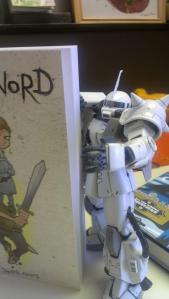
Gundam Pilots not eligible to win.
You do have to be a Goodreads member to enter, but who isn’t these days. Also, add me on there so I can be nosy and see what books you are reading.
I promise to actually blog a bit in the next week, updates on Riddle Box progress, nerd matters, etc. etc.
I dropped a few copies of the book off at the high school I used to work at, with strict instructions that they be dispersed only to the truly devout nerds in attendance.
Today I got an email from one of my teacher friends, and my very first piece of true Spell/Sword fanart. Also a sweet review:
Actually, I just finished the book right after I sent you the fanart. Overall, it was great. Maybe could’ve used a few runs of spell-check, but great overall. I’m a bit confused, though- you never really explained what Jonas did to earn the title of murderer. Is it going to be explained in the next book?
Also, your original cover is great. Really solid, yet open for ideas.
Dang, Andrew. Why you gotta be like that about the Spell Checkery? That’s to be expected with Artisinal Fantasy. [COPYRIGHTED.]
My heart is glowing in an embarrassing fashion. I’m so excited to put this on my internet refridgerator, and on my literal refrigerator after I print it out.
Thank you so much for the drawing and for reading the book, Andrew! I wrote the book for weird kids like you…and me.






 spell-sword.com