The first responses from my Alpha Draft readers are trickling in — mostly positive, but with a stern helping of jack-booted constructive criticism. I’ve already said “Well, here’s what I was going for — but oh god, you’re right. You’re absolutely right. I AM FILTH.” about seventeen times, and I’ve only heard from two readers.
I’d like to be more specific, but there’s still a lot of Alpha Drafts out there in the wild — and Science is my watchword on this process. I don’t want to pollute the other readers, gotta keep the sample clean. If I say that my readers are having problems with that centaur poetry in Chapter 11, then it’s sure to make all the other readers gaze at my sensual equine haiku with a more critical eye.
Just let yourself feel it. The rhythm, the majesty.
Lots of Lodestar writing, reading a colleague’s short story and novel chapters, plus day-job woes. Brain quivers and shakes, so no typey-typey, angsty-angsty today.
Toss a story idea in the comments, when I’ve reassembled the fragments, I’ll pick one and write something shiny.
Let me tell you about the first time I saw Fairchild.
I was working at Papa John’s — the day shift. I had just moved back to Athens after a blurred year away, and it was the first job I found. It was terrible money, and ultimately destroyed my car at the time — but hey, free pizza.
One of the big tasks that I had to do everyday, was food prep. All of the various pizza ingredients had to be carted out of the walk-in freezer. The cheese had to be fluffed [no-shit technical term], the meats had to be sorted — and all of the vegetables needed to be prepped fresh each day. The tomatoes were chopped, the onions were diced [pure misery], everything sliced and prepped with a big steel knife.
I hated it, but in a mute sort of way. It was systematic and mindless. Plenty of time to plot my escape, or let my mind wander.
For some reason, I really did enjoy cutting up the green bell peppers.
For the uninitiated, here’s the process. You cut off the cap [stem part] with a knife, then scoop out the seeds and guts inside. Then you would toss the whole thing into a big chopper with a crank, a few spins and out would come eviscerated vegetable.
It’s hard to explain exactly what I enjoyed about it. Other than the wanton destruction. The peppers were always nice and cool, and pleasantly crisp when you sliced into them. It was neat and self-contained, a little green world — protected by a thick barrier. Chop up onions, you get more onions — chop up a green pepper, you are Galactus.
One day I cut the top off of a bell pepper, and found something new.
Fairchild.
The pepper looked completely normal on the outside, maybe just a little twisty at the bottom — but inside was a tiny green growth, a nub of another pepper growing inside. It was a much brighter green then its host, almost fluorescent green, twisted and strange growing in the center of things.
My immediate thought : “This is what cancer is.”
Because it wasn’t a blight, or a bug — it was something that grew from within the little world, innocent and merry and green, green, green. All it wanted was to grow, and was blithely unconcerned with what that meant for rest of the pepper.
I’ve scanned the internet for a good picture of one of these things, and I absolutely cannot find one suitably impressive.
This is a red pepper, but you get the idea.
It was just so pleased with itself — that’s what struck me. So vibrant and wicked and sure of itself – it almost waved in delight to be discovered.
Look what I am doing, it said. It’s so very nice inside of here, would you like to pull up a chair? Things are going so well!
That image sticks with me. And so when it was time to create a villain for the last act of Lodestar — the green, green cancer sauntered into my mind, as blithe and merry as ever. A devil, a prince of devils dreaming of being King. A trickster and a manipulator — one so very, very sure of his success. Fairchild, the King of Glass. He had appeared in bit parts in other stories, but it was time for him to take center stage.
And if the heroes of Aufero aren’t most clever and potent, he will sit on the throne of my little world until the end of days.
But even if they succeed, I know the image of the green pepper in my mind will survive — so Fairchild will too.
A short story that features my green devil – The Cost – if you care to peruse.
Those are the two driving forces, theinspirado of a grand bulk of the genre. Either the writer has a really neat system of magic, combat or dragon-sex and they hammer a plot and some characters into a framework to hold it — OR the writer has a really neat world, or character, or setting for dragon-sex and they hammer a plot and some less interesting characters into a framework to hold it.
I’m not really complaining that these forces exist. [Especially about the dragon-sex.] I’ve invested a massive amount of geek-hours into consuming as much of this content as I can, and I never plan to stop. My complaint derives from the endless mimicry, and the bone-certain belief that these two masters are the only ones that the genre can serve.
That is not the case, more on that shortly. But first, a primer.
In general, there are two types of fantasy authors. Nerds and Dungeon Masters.
Nerds love their shining rules, and Dungeon Masters love their precious backstory.
So when you are reading a fantasy novel and realize you’ve just spent two pages reading about how Flame-aligned Slaughter Wizards cannot use their Flambe attack when Ice-aligned Tempest Mages have spent a fortnight attuning their Ava-crystals to the Fourteenth Ley Line —- then the author is a Nerd.
“Well, they can’t.”
Uh, thanks Mr. Sanderson.
And when you finish a blistering passage on the Archduke Sargasso and the five-year conflict he endured developing the Draconian Congress, including the Riddle-Game played in the jaws of Tyrinel the Inferno, Red Dragon Lord – with exacting minutes provided, including three water breaks and a complete rundown of the Inaugural Dylithic Council’s attire, facial hair and a five stanza limerick sung by Jargon the Time-Sworder — ALL of this read by the protagonist on a discarded scroll in the waiting room of his dentist’s office. Then, my friend, your author is a Dungeon Master.
“Roll versus Total Despair, bitches.”
Both of these ideas sound pretty awesome, and both of the authors above are titanium-plated awesome. There’s nothing wrong with either approach, and in a skilled scribe’s meaty grip each style can keep you patently enthralled. I’ve spent more than a few minutes thinking about everyday applications of Allomancy from Sanderson’s Mistborn series — and you better believe I’m far more concerned about the fate of the Iron Throne of Westeros than the outcome of the 2012 Presidential Race.
Democracy in action.
This isn’t about what those authors have already written. It’s about the fantasy that hasn’t been written yet.
The fantasy that you and I are writing. The new fantasy, which is also old fantasy — as opposed to the middle fantasy that we’re currently sitting in. The new/old fantasy where we basically don’t give a shit.
What am I talking about?
Swordpunk.
I have chosen this term because:
a) It sounds cool.
b) Fuck you, that’s why.
Are there rules? Yes, of course. But they are to be like a kindly sour-smelling uncle. You send them a card on their birthday, a sincere hug at Christmas — but you’re not inviting them over when it’s time to party.
Is there backstory? As long as there is linear time there shall be Stuff That Happened Before. But we shouldn’t drag it with us like those creepy dudes wearing their high school letter jacket to English 101. Leave that shit behind.
Not wearing pants.
And world building? Of course, building your own little bolt-hole from reality is the bleedin’ point. But why do we need to reinvent the wheel every time? Tolkien did it and generations of fantasy writers have been doing their best to ape him ever since. Too many fantasy writers think like Carl Sagan:” If you wish to make an apple pie from scratch, you must first invent the universe”.
How about we just have apple pie? You know, the apple pie that is at the store and we’ve all had it and we all know what it is?
Swordpunk is all about just eating the fucking pie.
I think the fear that fantasy writers have is that if they don’t reinvent the wheel, they won’t be taken seriously. Like Tad Williams is going to roll up and revoke their Fantasy License. [I’m imagining him in a lime green golf cart and wearing a jaunty scarf. Are you imagining it that way? Just me? Okay.]
The worlds are there. The tropes are there. It’s all in how you use them. I think there can be more power in connecting to the old stories, then running down the street and trying to start up your own Disneyland. “Oh, no — this ain’t Mickey Mouse, this is my own character Mouselord McQueen. He’s totally different.”
I don’t want to waste energy convincing you that my world is more clever or more original or ‘waaaaaay fucking different” [WFD] from any other fantasy author’s world. That’s a fool’s errand, and honestly more than a little outside of my skillset.
When I have a hero step forth and raise his sword, I don’t want to try to sell you on how he’s different than the inumerable sword-slingers in the genre. I want you to think of them. I want you to think of Sturm Bright-blade, Simon Mooncalf, Logen the Bloody-Nine, Brienne of Tarth, Lancelot, Garet Jax, Neville Longbottom, Reepicheep, Paksenarrion Dorthansdotter and Conan the Barbarian,
Pictured – License to be snooty and pedantic.
himself. I want you to think of them all. I want to connect to that resonance, that legacy of character.
Is it getting a little Joseph Campbell-y in here?
Beyond that, fantasy needs to be more of a wackadoo fever dream. I want more Fritz Lieber and Michael Moorcock – more Fafhrd and the Grey Mouser, more Elric of Melnibone. Beautiful little offshoots of the genre, grand and strange, bizarre and gleefully weird.
That’s what I’m trying to do at least, with Spell/Sword, my first novel. And if I can keep going, I’ll keep trying.
My book has rules. My book has backstory. [Shit, you better bring some Post-It Notes, dog.] I’m a Nerd and a Dungeon Master, just like all of you.
But thinking about these things, and giving them a silly name made me feel free. It made me feel empowered, it made me write the book I wanted to write — not the one that I thought would ever sell.
I hope it makes you feel the same.
Swordpunk
1. Eating the pie is more fun than making the pie.
2. No one cares about about your character’s grandfather.
3. Only trot out the Rules on special occasions.
4. Don’t let anyone tell you how to make your art. Make it. Make it scream and bleed, make it shine and shatter. Be true to the moment, to the beauty of it — and make no excuses for putting it on the page.
5. There should always be more minotaurs. Preferable riding on cherry-red mopeds.
And if Brandon Sanderson wants to start an internet feud, he can GET IN LINE.
Thanks for reading my ramblings. This is what happens when I’m not editing.
“The Long Night still comes, pup. But for now we are alive, and there is mead to be drunk.” Grell the Death crooked an arm around Agnar’s neck and dragged him away from the others.
The barbarian found hard hands on his shoulders, warm kisses from matron and maiden, the devil blood still spattered on his arms and face was smeared with bold cries by each warrior singing to the sun. The meadskin swung up and down, up and down and the honey-gold spilled down Agnar’s chin.
Then at once, there was space and silence. A tall warrior stood alone in front of a wide hall. Thunor Sky-
“Hish, Lord of Silence” Illustration from The Gods of Pegāna by Lord Dunsany, 1905
Breaker stood alone and faced his son. The dancing crowd fell quiet and hushed.
“Who is this warrior?” Thunor asked.
“This warrior is called Agnar.” Grell responded, a ritual.
“And what blood has he spilled?”
“The blood of our enemies. The black blood of Hell, the white blood of the Wolf and the red blood of the North. His own blood.”
“Is the blood good?”
“The blood is good.” Grell said.
“THE BLOOD IS GOOD.” Roared the gathered people of Marankur.
“Has he stood in the snow, has he broken bone, has he danced, has he sung in the flames?”
“All this and more.” Grell said.
“Who is his father?” Thunor said, dark eyes locked with Agnar.
“His…his…”Grell stopped, and looked to his chief for aid. Thunor said nothing, his face cold and hard with a lifetime of pride. A murmur of discomfort rippled through the crowd of gathered barbarians.
1. I’ve been working on my very first novel. [QUIVER. CLENCH. ANXIETY-NINJAS IN MY STOMACH.] I started working in September, and completed the very, very rough draft in April.
2. I’m coming around the bend on my first round of editing. Soon I will let a few Alpha Readers take a long look, before they solemnly set fire to my manuscript and without breaking eye contact — dial the authorities.
3. While I try to stay focused on the craft itself of working on the book, I have noodled around a bit on The Next Step. The world of traditional publishing is contracting, and it’s never been known for being an easy assault for new talent — so, most of my thoughts have been centered around Self-Publishing. With resources like CreateSpace via Amazon it’s childishly simple to do, and I could have the most basic unit of my goals with a modicum of time and effort — i.e. a paper book that I slap in my mom’s hands.
4. I heart Pat Rothfuss. Name of the Wind and Wise Man’s Fear are excellent books. Wise Man’s Fear is one of the only books I can ever recall finishing …then immediately starting to read again. Slowly, languorously. I went on to read other things, but I would circle back like a honey-drunk bee to take another sip. I read that cat’s blog religious — and all of this novel nonsense is so I can send him a copy [right after my mom] and then he’ll read it and think I”m awesome and that we should be best friends and then he’ll come to my birthday party. THIS WOULD CLEARLY BE HIS REACTION TO MY WORK.
So, contextualized?
Today I read an interview he gave, linked into his own blog.
I was chuckling at his wry humor, and stroking my chin at the interesting bits — when I came to this section:
PR: Not really. Because, as I mentioned, I wanted people to read my books.
I know there’s a lot of talk about self-publishing right now. Everyone’s giddy with the possibilities. And I’ll admit that it looks good on paper: sell your books directly and keep a bigger chunk of the profit for yourself. No rejection letters. No hassle with agents. Sounds good, right?
Except nobody knows who you are. And nobody really cares. And your book is mostly crap because you haven’t had a substance-level editor give you feedback and make you revise it a couple of times. And your book is full of typos because you didn’t have a copy-editor read it. And the layout is ugly because you don’t know anything about layout…I’m sure you get the picture.
It’s like the query letter problem that I just mentioned, magnified a hundredfold. You might be good at telling a story, but that doesn’t mean you know anything about marketing. Or layout. Or editing. Or publicity. Or selling your books for foreign markets.
Even if you’re surprisingly good at one of those things, you’re still not going to be as good as a professional. You don’t know the tricks of the trade. You don’t know the right people to call. You don’t know what mistakes to avoid….
Everyone can point to a few examples of people that have done very well for themselves self-publishing. But honestly, those folks are lucky as lottery winners. They’re statistical anomalies. You want to publish with a publisher because a publisher knows how to publish a book. And you don’t. You really don’t.
Woof.
Dang.
Now, first and foremost, this isn’t about how Pat Rothfuss broke my heart, or what a big meanie-face he is, etc. etc. His beard is made of laughter and moonbeams, people. From my EXTENSIVE PERSONAL KNOWLEDGE [aka reading his blog.] he is clearly not a malicious person in any way. He was speaking from his own experience, trying to give helpful and clear advice.
It was a bit stern, and absolutist — but then, I remembered — Nerd/DM High Speech. Nerds speak in absolutes, with unwavering knowledge about whatever topic is in our demesne. It probably comes from being the smartest kid in the class, or years with our finger pointing at the small print in the Player’s Handbook. We all delight in pronouncing This is how it is. This is how it works. No, you cannot gain access to 6th level spells, just because you have a magical ability that increases your effective caster level, Carbunkle.
No, this post is about my reaction. I felt foolish.
Here is a writer and person that I respect telling me that I’m functionally wasting my time. I will self-publish my novel and it will be garbage. It will not be discovered, it will not be read. I am doing a disservice to myself and to the work itself by going this route. Pat Rothfuss told me I was an idiot.
This is not how my fanfiction plays out AT ALL.
I don’t think he’s wrong. I don’t think he’s right either.
For the vast majority of people self-publishing, he’s absolutely right. We all need to hear the stark truth like that. A wake-up call that if your goal is financial success then you are setting yourself up for failure. You are not some maverick Hemingway blazing across the firmament while thumbing your nose at traditional publishing. If you got into this gig to be the next 50 Shades of BLAHBLAHBLAH, then you are in it for the wrong reasons. Take a glance at the amount of self-published drivel on the Amazon Kindle alone. His metaphor of winning the lottery is apt. Every writer can benefit tangibly from a trained editor, copy-editor — and the inarguable expertise in marketing and layout that a publishing house can bring to bear.
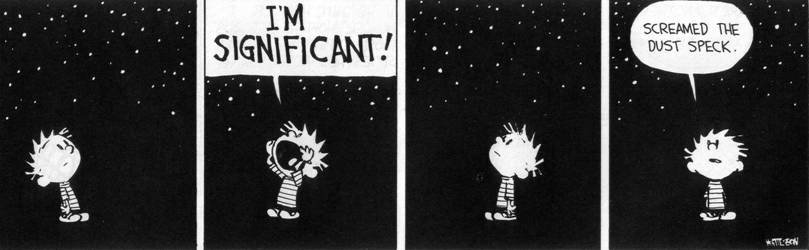
But, I’m special. SCREAMED THE SPECK OF DUST IN A TRANSPARENT ALLUSION TO THAT CALVIN AND HOBBES STRIP.
YOU KNOW, THIS ONE. [I miss Bill Watterson.]And beyond that, I do believe that traditional paper publishing is in its dotage. We’re caught in the weird wilderness between traditional and digital publishing, and all the old dinosaurs are late to the game. The tools are all laying around [editing, design, computers with blinky buttons] — what’s to stop us from selling and promoting our own work digitally direct to our audience? John Scalzi almost pioneered this concept, releasing his work chapter by chapter on the web, then backed into traditional publishing after he had already built a readership. And he’s the president of the freaking Science Fiction and Fantasy Writers of America, now!
There are more options now then ever, so more people than ever are going to chase the dream their own way. So, yeah, me too basically.
I have taken his thoughts to heart. I’ve always considered self-publishing the book as a first step, a tool to one day get picked up by a publishing house. The first book is a resume for the new job I want to have.
I hear you, Pat. I really do. But I am mercurial at best — I just can’t stay motivated with the idea of finishing the book THEN enduring two years or more of frustrating query letters, and standing like a beggar outside the big publishing houses wearing an adorable Dickensian top hat.
Well, maybe the top hat.
So, I’m sticking to my guns. Alpha Readers in July. More and more editing after that, and then when I say done I will use this fancy InterWebamaphone to put my book into people’s hands and on their fancy e-readers.
And I’m still sending you a copy, Pat. I’ll save you some cake, and a brightly colored hat.
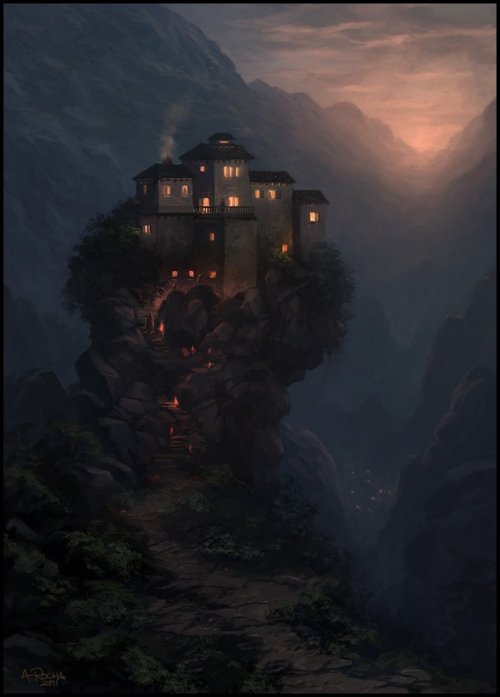
A small village, directly in the center of Riddlewood. Human settlers were first drawn to the ancient forest
Retreat by Andreas Rocha
by an accidental discovery. A traveler was camping underneath one of the ancient elms, boiling some water for soup when an acorn fell into the open pot. The traveler didn’t notice right away, and by the time he did the water had turned a brilliant shade of green. History does not tell us much about this traveler but one thing is clear – – he either had an overgrown sense of adventure, or a serious deathwish. For no apparent reason he decided to give the concoction a taste. He poured off a tiny draught of the green liquid into a dented tin tankard, and tossed it back.
He woke up several hours later, his teeth stained the color of the leaves.
This unknown traveler had just discovered the remarkable soporific effects of the Riddlewood Elm. Folk tradition contends that he spent the next several weeks finishing the emerald concoction, one sip at a time — but regardless, at some point he stumbled back to civilization and somehow convinced one of the larger merchant families to invest in his new scheme. A team of brewers, apothecaries, and loggers would make their way into the heart of Riddlewood. They would harvest the amazing acorns, determine the best way to render them safely potable and marketable, and the other, lesser trees could be cut down to make casks and barrels for the new concoction. A troop of soldiers were also included to protect against the mysterious and sly wood elves that lived in the forest.
For the first few weeks, the newly christened “Barreltown” hummed with activity. Acorns were gathered, brewed and tested. Hundreds of trees were felled to make barracks, fences, and a multitude of barrels — the saw mill ran day and night. The soldiers quickly grew bored as the wildlife of Riddlewood gave the new town a wide berth, and the wood elves were nowhere to be seen. With nothing else to do, they joined in the construction of the town, their first project a suitable saloon.
Reports vary on the events that followed, but the central theme is agreed upon by most accounts. A young soldier took to wandering the green halls of Riddlewood out of sheer boredom and restlessness. She was the youngest member of the troop, though well-trained in the ways of sword and shield.
The soldier came upon a clearing where a large red tiger lay dying, caught underneath the trunk of an oak tree that a careless logger had felled, then abandoned. Without stopping to consider the danger, she ran over to the creature and with a great cry flung herself under the tree. Arms and legs straining she pushed the felled oak up far enough that the red tiger could just barely wriggle out.
She dropped the tree in exhaustion – only then realizing that she had dropped her weapon at the clearing’s edge, and stood completely defenseless against the wounded animal.
To her surprise, the red tiger rose wearily to its feet and made no move to attack. It looked at her curiously, then padded off into the forest.
The soldier returned to Barreltown and told all who would listen about her amazing experience. A few believed her, but she was met with more than a few mocking japes. She became obsessed with proving her story, and spent much of the next few days prowling through the forest looking for tiger tracks.
Tigers, like most cats, appear when they please.
By Rui Tenreiro.
The young soldier was keeping the late watch one night, when she felt her eyes beginning to droop. She stomped her feet, and put pebbles in her shoe, but weariness stole over her. With a start, she awoke at moonfall, a bare hour before dawn, to find the red tiger sitting quite calmly on a felled tree trunk in front of her.
The red tiger stood, and walked a few paces before turning back to look at her. The intention clear, the soldier gripped the hilt of her sword closely and followed.
Through quiet clearing, and silent tree, through moon and leaf-rustle night. The guttering torchlight of Barreltown vanished behind the young soldier, and yet she continued on.
At last, the tiger stopped and turned to face her. The wind blew, and the tiger changed. A beautiful young wood elf, with hair as red as the tiger’s.
Without speaking a word, he knelt before a ragged stump of a tree and placed both hands upon it. He sang quietly, and the soldier was surprised to find tears running down her face.
Between the palms of the wood elf, and guided by his song the tree trunk began to grow. Forming and changing, shaped by his will as a potter turns the clay. A tiny barrel formed, sound and true — then with a sharp twist he broke it free and pushed it into her hands. The soldier held it up to the rising sun, and saw how well it was crafted. Sound and true, with nary a crack — better than any one in Barreltown could hope of making.
“Why would you take, what the forest would happily give?” the wood elf asked.
The soldier had no answer.
Time passed. The soldier and the wood elf spent much time in each other’s company. Love was given and returned, and the two hatched a plan.
Early one morning, the soldier and the wood elf walked into Barreltown hand in hand. They marched directly into the mess hall where all the loggers, apothecaries, brewmasters, tradesmen and soldiers ate their meals. The soldier cleared off a table and called everyone’s attention, and the wood elf plead most eloquently for the forest of Riddlewood. He finished his speech, then showed the gathered crowed how wood could be shaped and sung from the living trees, without harm.
And the people listened. They understood. And they agreed.
To the vast shock of historians throughout the world, the people of Barreltown agreed that it was a great
By Annemarie Rysz
idea. This incident is hotly contested in many scholarly circles, as it goes counter to entire schools of socio-political thought. Some even go so far as to claim the story is completely fabricated, a convenient fiction crafted by the wildly successful Riddlewood Brewing Guild.
Regardless, two hundred years later the village still remains. Barton is a reasonably prosperous hamlet, most of the residents splitting their time between farming and the seasonal work on the factory floor, brewing and bottling the various ales and liquors distilled from the trees of the forest — great casks filled to brim, tight and sound made from living wood. Only the very oldest buildings in the town show the sign of an axe or saw, the rest are all formed carefully and beautifully by the druids of Barton.
The village is roughly split between human and elven populaces, with intermarriage common. The sigil of Barton is a red tiger with a green acorn in his jaws. The village is led by Count Pel Marlowe, his family owns controlling interest in the Riddlewood Brewing Guild.
Did another guest post on Town & Gown Players, if you care to read my ruminations on the process of line memorization. [It’s totally more interesting than it sounds.] Click on Iron Chef French’s benign visage to be whisked to that blog.
Hyper evolved frogs on steam-powered roller skates: 76
Weird dream sequences: 2
Witches: 1
Allusions to Buddy Holly lyrics: 1
Swords named ‘Chester’: 1
Word count: 49,235
I like my book. It’s got problems, but I don’t feel overwhelmed — YET. Several sections are in severe need of fleshing out, clarification and a rigorous, rigorous edit. The next stop for the Edit Train is working on the chapters individually, probably save the first couple of chapters for last as they’re going to need the most work.
 The first responses from my Alpha Draft readers are trickling in — mostly positive, but with a stern helping of jack-booted constructive criticism. I’ve already said “Well, here’s what I was going for — but oh god, you’re right. You’re absolutely right. I AM FILTH.” about seventeen times, and I’ve only heard from two readers.




 spell-sword.com