Gilead Excavation

[Some old words about Gilead – putting them here for easy research later.] 

The waters ripple, and Haskeer sees Gilead.

A gray city, made from simple stone. The towers and streets show signs of great age, and great wear. This is a place where it rains much, where the people must go to the walls to stand against an endless tide of dark. Yet in every eye, a fierce pride – a bright flame that burns against the dark. The people move about their day, and among them walk the men of the Legion. The Crusaders, the Swords of Iron – their cloaks white and blue. Their armor is brightly polished, but the paladin quickly sees the signs of steady use. Leather straps worn to fraying, dents in shields carefully beaten back to true, and burnished with care.

Pennants fly from the towers, each showing three swords bound in a circle, blue on a white field. In the streets Haskeer sees simple signs of nobility, peace and kindness. A young boy keeping his older brothers from harming a kitten, an old man doffing his cap for a passing milk maid, a portly baker giving barely stale bread to beggars in the church square. The quiet prayers at the temple of the Nameless God, the priests laying hands on their flock with the gentle touch of wise shepherds.

A king with a golden crown, white hair spilling down his collar – his family drawn close around a fine table. A plan is laid out before them, a bridge that needs building — the family laughs and argues good naturedly over the plan.

“This is Gilead.” the lady said. “The anvil where the hammer falls again and again, but the steel does not break.”

The lady smiles, one tear coursing down her face.

“This is Gilead, Sir Knight. You asked to see it. No other place in this world will ever be Gilead again. If you wish to see the place that was once Gilead, then look.”

A gray city, made from simple stone. The streets are clean, not a speck of trash or debris. Repairs have been made to shore up sagging towers and crumbled buildings. The devils move through the streets with frenzied care, putting each plaza and wall into precise, scouring order. The windows burn with red and green light, strange shadows move in complex dances of pain and perversion. Armies march in a rictus of order, regiments of the damned.

Pennants fly from the towers, each showing three swords bound in a circle, blue on a white field. The fabric is stained and tattered – a mockery, pulled from rotting basement and dusty museum to dance on the wind and laugh in the face of the defeated dead. An imp slices red dripping meat into squares to sear on an open flame, a winged horror cavorts with a brace of bound creatures on the top of a broad wall – it’s face twisted with lust, an obese monstrosity hangs sluglike from underneath an archway cramming stones wrapped in grass and goat-cheese into it’s ever widening gob. Tall, angular creatures move amongst the devils wrapped in long red robes – they are treated with deference, and are quick to punish any that do not show the proper respect.

A king with a crown of glass, grass-green skin and bone laughs in a high-backed wooden throne. Behind him in a circle of steel is bound a man of average height and average features. He looks up, as if he is aware of being watched and winks.

The pool ripples and Haskeer can see no more.

The Riddle Box – Music

“You know a lot of things. I say it, so you can hear it. It is very important that we all know this about you, yes?  You know a lot of things. Things and springs and wheels and the click-clack of numbers falling in a row. But music?” Geranium tapped a staccato beat, two fingers on the pulse of his wrist. “It cannot be known. You can’t contain it, you can’t weigh it, you can’t put it safe on a shelf or bury it down in a hole. There is a reason that the Songs of the Lost still haunt us, that the simple melody in children’s games hum and burn in our temples as we clutch the pension-staff and stumble our way towards the grave. There is a reason that I walk penniless and proud down dark roads, with only my guitar as companion, as every true Bard of Gate City must.”

“What does –”

“Quiet now,” the bard raised two fingers to his lips. “Listen and remember. It binds as it breaks, it slips up the tallest castle walls and shivers its way into the darkest of hearts. It burns as bright as the sun, warm as an oven while I stand on the stage. I sing and every eye is mine and every heart is mine and every secret unfolds and the music drinks tears and shines and shines and shines. One song, the right song, one song for every heart. Even if they’ve never heard it, even if the song hasn’t been written yet, there it is, quarter notes and red blood on the parchment. And when the wind is at my back, I can see it. I can hear it.”

The bard’s eyes shut tight.

“And if I can sing your song, I can break your heart.”

Rime interrupted sourly, “Ridiculous.”

Get Back into the Fight

image

And so we begin again. Careful and slow, the embers spark and the cold howls the ramshackle hovel I call me.

We begin again. With the dull swords and halberds of rust we clutch and stammer in the wendigo afternoon. Turn and face, about-step and lunge.

I remember the way. My demons have taught me well. Cruel mentors are the surest sages. Rime knows this and Jonas will learn.

Again the weight and again the City of Rain. Again the fading halls and the broken sunlight. I have built my army well, I am not just what you see. I give my words away but the doors remain shut.

Keep faith in the gatekeepers.

We begin again. I am not alone. I have miles to go. From black earth risen, I burn like the Third Moon.

Stand shoulder-wide with me and shout. This is not the day we die. Jangle skeletons and foul-diamond horde. Ogre-pain and empty wind. We stand to face you. You, and your master, the Patient Dark.

This is not the day we die.

We begin again.

Wordy-type Makings: A Blog Hop


2014-02-23 14.32.39-1

And now I catch the baton from my friend and sadly distant conspirator, Leigh from her blog Fun Things To Do While You Are Waiting. You absolutely should navigate your web-machine to her and Coralie’s site – it’s a lifestyle blog with tons of crafty adventures and receipes — much more regularly updated than my site. I’m terrible at these blog chain letter sort of things – the fun premise will quickly descend into navel-gazing, but I’ll try to keep it frothy.

What am I working on? 

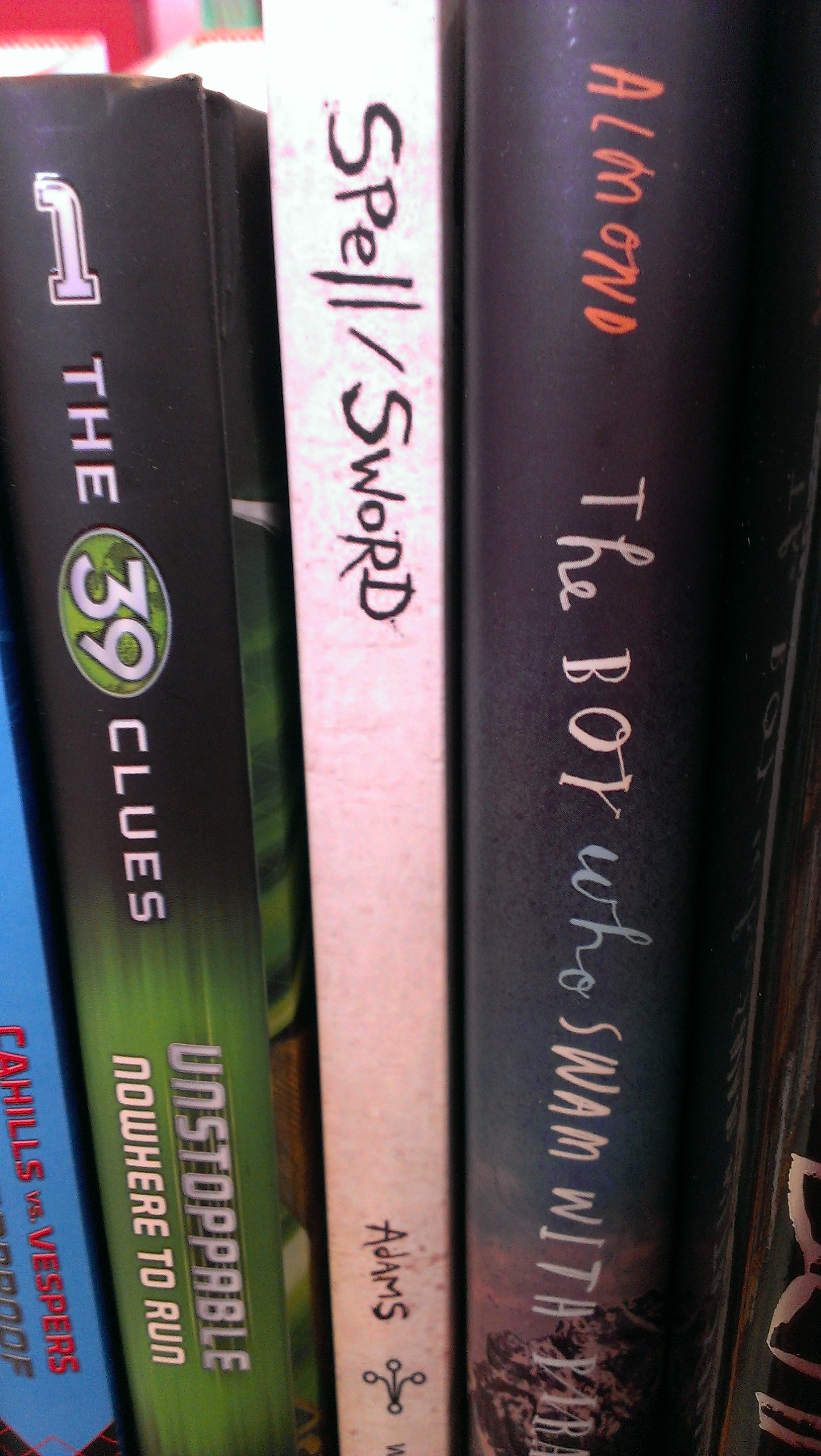
I am working on the final re-writes and edits on The Riddle Box, the sequel to my previous novel Spell/Sword.   I’m hoping to have it ready to publish in another month or two. This brings to a close several months of editing — AKA the part I hate. I’m very excited to get it out there for people to read – but more excited to be able to start work on the third book, working title: Asteroid Made of Dragons.

Side projects — writing for three Pathfinder campaigns, game prep, world information, and forum play.

How does my work differ from others of its genre?

I’ve expounded on this at great length in the past, but let me boil it down. I’m a special snowflake and everything I do is unique and wonderful.

The name I’ve given it is ‘Swordpunk’, but through my research I’ve found that Terry Pratchett has a much better term for it – the ‘consensus fantasy universe’ – that place we all understand instinctually without need for qualification or endless description. Dragons can fly and are mean, a hero with a sword is generally a good thing to have on hand, witches are potent, elves have pointy ears, etc. etc. etc. As much as I love the current heights of epic fantasy [Martin, Rothfuss, Sanderson, Abercrombie] – I’ve grown weary of the genre taking itself so seriously. Also by traipsing in this ‘consensus’ universe, I don’t have to waste any time or reader brain wattage to re-invent the wheel. We can jump right in and get to the action.

Also my work is not particularly popular, so there’s that.

 Why do I write what I do? 

HRMMM. That’s kind of a brain bender. I don’t know if that’s even the sort of questions I’m equipped to answer. Who knows what strange events and mental misadventures have resulted in my own particular output?

I do know that the forms of fantasy make sense to me. As a writer you’re usually trying to express something – something simple, or something profound – and you grab whatever tools are at hand to get the point across. Swords make sense to me, magic is the perfect metaphor. I think if I tried to write a story set in modern day about emotions, or culture, or banking — I would only make it a few thousand words before goblin-gunners start erupting from storm drains or roc’s land on the top of city buses.

The fun part of my work is I’m absolutely certain there’s some grand point I’m trying to get across — but I’m usually mystified about what exactly it’s supposed to be. I stumble into bits and pieces of the message as I keep rambling on, but completely by accident. My crafty subconscious has something to say, but it whispers in hindsight, in the corners of things.

Spell/Sword  is the pilot episode, so a lot of its energy is spent on getting my heroes together and starting some plates a-spinning that won’t resolve until years in the future – but I like to think there’s a nice through-line about Friendship. The Riddle Box is much more on point as I grapple with my thoughts on depression, and the sick, strange madness that haunts all human endeavor.

How does my writing process work?

I am a ‘discovery writer’ as the lugubrious buzz-term goes. I don’t plot or outline in advance, though I do have a skeleton plot in my head — or rather I have big moments and fight scenes like sign posts on the road ahead. Spell/Sword I had only the most basic of ideas of where I was heading — The Riddle Box, as a murder mystery, I had to know ‘whodunnit’ so I could reverse-engineer the plot. I know outlining is king if you want to truly focus on a marketable product – but I couldn’t go to work if I knew every twist and turn, half the fun is getting to see these moments for myself.

Beyond that, I try not to fetishize my process in any way. I don’t have a set time, or place, or a special mug that I have to have with me. I set myself easy deadlines, of between 5-10 pages a week [depending on the insanity of the rest of my life] and get to typing. I write when I have time between work and home, just as long as I’ve turned in my pages by the end of the week, everything’s kosher. Admittedly, I’m bad about putting it off until Friday or Saturday and jamming out that week’s allotment in one quick stretch. If I get in a groove and write more than my allotment – that’s great! – but I can’t bank anything in advance. Each week is always 5 pages more than where I ended the previous week. I write chronologically — mostly because I have to ‘discover’ the scene, but partly because if I wrote all the fun stuff first, I’d never go back and write the connective tissue.

That’s it – I just keep chugging along until I get to the end. [Or at least what I think is the end.]


Huzzar! I have completed my blog hop — of course, I haven’t had the forethought to get anyone else to take the next leg from me. So,  yeah — any of you want to take the next leg? Ping me in the comments for my thanks and blessings.
Absentia

2014-04-14 13.57.20Okay, Oklahoma! is complete and as I slowly nurse the post-show hangover and emotional detritus, time to start sorting through the rubble of the rest of my life. Big things on the horizon for The Riddle Box as I finish the final re-writes, start getting the first drafts of the cover design – I had my first public appearance ever as a writer at Avid Bookshop, here in Athens – that was a crazy thing that happened. Participating in a ‘bloghop’ next week, got three Pathfinder games to prep, a new house to find and rent, visits to plan, and dishes dishes dishes laundry laundry laundry.

Sometimes I wonder about the gigantic energy dump that directing a show is — it effectively puts everything else creative in my life on hold. As I start to get more and more involved in the writing aspect of the manga-adaptation of a Faulkner novel that is my life, I do wonder if it’s something I’m going to be able to keep doing as – hopefully – writing and promoting myself will require more and more energy. I find directing enormously satisfying – but as with most art I do – there’s also some odd psyche resonance and strange internal machinery involved that leaves me feeling a bit odd in the wake of it.

But yeah, expect more rambling in this space.

Apocryphile

My friend across the table muttered something in passing and my blood went cold.

“Did you just say, Apocryphile?” There was no reason she could possibly know what it meant, I tried to stay calm, hands flat at my side.

“Uh, what? No,” she replied.

The ‘Apocryphile ‘is a name of ill portent, a character from a set of stories I thought I had escaped, a year-spanning tabletop of four-color glory. A villain of quiet wit and patient menace. One of Steven Carroll’s devils. For a split second, I legitimately wondered: am I still playing that same game? Have all the stories and games and dungeons and adventures since that game been nothing but a long con? Am I still wandering through the streets of New Babylon? Any moment now my phone will buzz and razor-sharp letters will blaze.

get to waffhut, funtime back in town, dont tell liz

The devils we create, the stories that we tell — the strange grip an imaginary name can squeeze from it’s imaginary heart. These worlds were ours and they linger. They linger indeed.

World Under Construction – Matters Divine

Pray to the Gods if you must, but do not mention my name if you catch their ear.
—  Dwarven saying.

Cynus is a strange land, filled with an extremely diverse population both racially and culturally. Some scholars have made note that the widespread worship of the Balance across many geographic and ethnic divides is less than likely  but those same scholars keep these observations private. This pantheon of primal gods are not known for their positive attitude towards criticism or mortal interpretation.

The Six, as they are sometimes called, also provide ample proof of their existence on a regular basis. Sometimes in the form of a vicious sandstorm or a unexpected drought or an earthquake on the eve of winter. Other times in the blessings of a bountiful harvest or a sudden break in a heatwave or a gentle breeze on the eve of summer.

The foremost are Father Order and Mother Chaos. Their names are never spoken, one out of respect, the other out of fear. These deities affect and scope are so beyond the mortal ken that they have never recognized any sort of church or acolytes. A few have appeared throughout the centuries, but none were able to display any sort of true connection or divine power, so they soon were discredited and forgotten.

Mortals have much more luck with the other four gods, the children of the Two. Or perhaps it is misfortune, because the other gods never tire of meddling in the affairs of the world. And much like the four elements they represent they can bring great bounty and great destruction to the world in even measure. It is said that Father and Mother ceased their tireless battle only once to couple, but only with the foreknowledge that their children could multiply the conflict between Chaos and Order a thousandfold.

Seto – Goddess of the Sun [Fire]
Banu – God of the Sea [Water]
Marrus – God of the Sky [Air]
Jocasta – Goddess of Stone [Earth]

The gods are neither malevolent nor benevolent, not truly. Human experience and custom has lead many to consider Seto and Banu as generally more giving and understanding than their siblings — but a flood can still drown, and the sun can still scorch.

The Children of the Balance speak when they have a will, through their chosen vessels – clerics, paladins, druids, oracles. But any can invite the gods’ attention through the proper rituals — though this is usually done only at times of great need.

A few other deities are recognized in some locations throughout Cynus, and they seem to have similar influence to the Balance. The worship of these minor gods seems to have begun during the Blank Time, a period of years where the the entire pantheon of the Balance seemed to have vanished entirely.

World Under Construction – Matters Divine

Pray to the Gods if you must, but do not mention my name if you catch their ear.
—  Dwarven saying.

Cynus is a strange land, filled with an extremely diverse population both racially and culturally. Some scholars have made note that the widespread worship of the Balance across many geographic and ethnic divides is less than likely  but those same scholars keep these observations private. This pantheon of primal gods are not known for their positive attitude towards criticism or mortal interpretation.

The Six, as they are sometimes called, also provide ample proof of their existence on a regular basis. Sometimes in the form of a vicious sandstorm or a unexpected drought or an earthquake on the eve of winter. Other times in the blessings of a bountiful harvest or a sudden break in a heatwave or a gentle breeze on the eve of summer.

The foremost are Father Order and Mother Chaos. Their names are never spoken, one out of respect, the other out of fear. These deities affect and scope are so beyond the mortal ken that they have never recognized any sort of church or acolytes. A few have appeared throughout the centuries, but none were able to display any sort of true connection or divine power, so they soon were discredited and forgotten.

Mortals have much more luck with the other four gods, the children of the Two. Or perhaps it is misfortune, because the other gods never tire of meddling in the affairs of the world. And much like the four elements they represent they can bring great bounty and great destruction to the world in even measure. It is said that Father and Mother ceased their tireless battle only once to couple, but only with the foreknowledge that their children could multiply the conflict between Chaos and Order a thousandfold.

Seto – Goddess of the Sun [Fire]
Banu – God of the Sea [Water]
Marrus – God of the Sky [Air]
Jocasta – Goddess of Stone [Earth]

The gods are neither malevolent nor benevolent, not truly. Human experience and custom has lead many to consider Seto and Banu as generally more giving and understanding than their siblings — but a flood can still drown, and the sun can still scorch.

The Children of the Balance speak when they have a will, through their chosen vessels – clerics, paladins, druids, oracles. But any can invite the gods’ attention through the proper rituals — though this is usually done only at times of great need.

A few other deities are recognized in some locations throughout Cynus, and they seem to have similar influence to the Balance. The worship of these minor gods seems to have begun during the Blank Time, a period of years where the the entire pantheon of the Balance seemed to have vanished entirely.